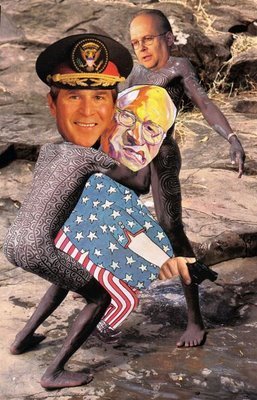
Thursday, October 26, 2006

Since When Has Wasting Money Become A GOP Hallmark?

Please be seated. I'm pleased that you all are here to witness the signature of the Secure Fence Act of 2006. This bill will help protect the American people. This bill will make our borders more secure. It is an important step toward immigration reform.
Am I the only one that thinks putting up a fence along the Mexico border is a giant waste of money? Sure, I'm in favor of legal immigration - that's how my family got here. But a fence? That isn't going to solve the problem.

Given the propensity for graft amongst our politicians, I can't help but wonder who is going to be the big winner when the fence building contract is awarded and what connections some politicians will have with that company.

This leads me to the real topic of this post - since when has wasting taxpayer dollars become a GOP hallmark and modus operandi? I thought the very definition of "conservative" meant that the GOP would be the party of parsimonious expenditures with policy expedited with a miserly akin to Ebenezer Scrooge. But alas, I am unrequited.

The NYTimes Editorial staff puts it this way:
When the full encyclopedia of Bush administration misfeasance in Iraq is compiled, it will have to include a lengthy section on the contracting fiascos that wasted billions of taxpayer dollars in the name of rebuilding the country. It isn’t only money that was lost. Washington’s disgraceful failure to deliver on its promises to restore electricity, water and oil distribution, and to rebuild education and health facilities, turned millions of once sympathetic Iraqis against the American presence.

Their discovery that the world’s richest, most technologically advanced country could not restore basic services to minimal prewar levels left an impression of American weakness and, worse, of indifference to the well-being of ordinary Iraqis. That further poisoned a situation already soured by White House intelligence breakdowns, military misjudgments and political blunders.

The latest contracting revelations came in a report issued Tuesday by the office of the Special Inspector General for Iraq Reconstruction. The office reviewed records covering $1.3 billion out of the $18.4 billion that Congress voted for Iraq reconstruction two years ago. Reported overhead costs ran from a low of 11 percent for several contracts awarded to Lucent to a high of 55 percent for, you guessed it, the Halliburton subsidiary, KBR Inc.

On similar projects in the United States, overhead is typically just a few percent. Given the difficult security environment in Iraq, overhead was expected to run closer to 10 percent. But in many of the contracts examined, it ran much, much higher, in some cases consuming over half the allocated funds. And the report may have actually underestimated total overhead because the government agencies that were supposed to be supervising these reconstruction projects sometimes failed to systematically track overhead expenses.

The main explanation for these excessive overhead rates turned out to be not special security costs but simply the costly down time that resulted from sending workers and equipment to Iraq months before there was any actual work for them to do. That is yet another example of the shoddy contract writing, lax oversight and absent supervision that has consistently characterized Washington’s approach to Iraq reconstruction from the start.

Bush administration incompetence, not corporate greed, is the chief culprit. Still, these charges are one more example of how the favored American companies lucky enough to be awarded reconstruction contracts made large sums of money while the Iraqis failed to get most of the promised benefits.

As Americans now look for explanations of how things went so horribly wrong in Iraq, they should not overlook the shameful breakdowns in reconstruction contracting. They need to insist that Congress impose tough new rules on the Pentagon to ensure more competitive bidding, tighter contract writing and more rigorous supervision. That is the best way to ensure that such a costly and damaging failure never happens again.

Wednesday, October 25, 2006

Video The Vote

Here's an intersting idea:
Last month we told you about GNN's new film American Blackout that uncovers the issue of voter disenfranchisement that occurred in the past presidential elections. Many of you expressed your outrage after watching the film. Now there is something you can do about it as a part of the End The Blackout Campaign for the '06 mid-term elections.

On November 7th, join us as we "Video the Vote"--a team of everyday Americans dispatched with cameras to capture problems with the vote as they happen, and pushing them through the media on Election Day. To participate, all you need is a video camera, a cell phone, and the ability to get to problematic places on Election Day, should something
happen. No camera? You can still volunteer to help dispatch videographers or with logistics. Join us as we enter a new stage for GNN, working together as an active community of citizen journalists. Watch the promo video and sign up today at:

http://www.videothevote.org

-- American Blackout Team

The Big Iraq Gamble: Is The Return Worth The Bet, Or Should We Get A New Set Of Dealers For The House?

I don't like gamblers. They take giant risks and often lose huge sums of money. That's fine when the loss is constrained to their own coffers. But when people borrow to make bets, and then lose, they deserve what's coming to them.

Unfortunately for us, the W, Rove and Co made a huge gamble that the Iraq conflagration would turn in our favor using a super-sized jumbo loan borrowed on the backs of the American Taxpayer for generations to come, not to mention the lives of many lost for their "noble cause." The question is, has the bet paid off?

Today, in an every widening and ratcheting up set of PR junkets, the President is in a desperate frenzy to prove to the American people that he and his party have lead us to the right craps table. I remain unconvinced.

Let's have a look Wednesday's Presidential Press Briefing and make a judgment of our own as to whether or not we think the sizable bet the W, Rove and Co. laid down has yielded any kind of return.

Let's look at the newly articulated "strategy" that W is trying to spin his way:
First, we're working with political and religious leaders across Iraq, urging them to take steps to restrain their followers and stop sectarian violence.

Second, we're helping Iraqi leaders to complete work on a national compact to resolve the most difficult issues dividing their country. The new Iraqi government has condemned violence from all quarters and agreed to a schedule for resolving issues, such as disarming illegal militias and death squads, sharing oil revenues, amending the Iraqi constitution, and reforming the de-Baathification process.

Third, we're reaching out to Arab states such as Saudi Arabia, the UAE and Jordan, and asking them to support the Iraqi government's efforts to persuade Sunni insurgents to lay down their arms and accept national reconciliation.
I see. Is that working? Judging by the intensity and frequency with which the sectarian factions are killing each other, I would have to say: nope.
We're pressing Iraq's leaders to take bold measures to save their country. We're making it clear that America's patient [sic] is not unlimited.
Well, that we are not an infinite pool of patients is correct, but I'm not certain that the wagging middle finger of blame should point solely at the Iraqi's here. I thought W had repeatedly billed us as the Iraqi's saviors, no? But wait, there's hope.
A distinguished independent panel of Republicans and Democrats, led by former Secretary of State Jim Baker and former Congressman Lee Hamilton, is taking a fresh look at the situation in Iraq and will make recommendations to help achieve our goals. I welcome all these efforts. My administration will carefully consider any proposal that will help us achieve victory.
Excuse me for a second here? I thought that W was only going to be making decisions about tactics based on feedback from generals in Iraq? What happened to the credibility of those boots-on-the-ground?

Ah, but let's have some fear tossed at us so we can see how clearly W is able to predict the future and get us to toss more money onto the Iraqi craps table:
If we do not defeat the terrorists or extremists in Iraq, they will gain access to vast oil reserves, and use Iraq as a base to overthrow moderate governments across the broader Middle East. They will launch new attacks on America from this new safe haven. They will pursue their goal of a radical Islamic empire that stretches from Spain to Indonesia.
Really? Nothing makes a gambler place a new bet faster than the fear of losing. But do you think Saudi Arabia will allow that to happen?

But where is the proof that the bet is paying off?
Q Are we winning?

THE PRESIDENT: Absolutely, we're winning. Al qaeda is on the run. As a matter of fact, the mastermind, or the people who they think is the mastermind of the September the 11th attacks is in our custody. We've now got a procedure for this person to go on trial, to be held for his account. Most of al Qaeda that planned the attacks on September the 11th have been brought to justice.
I thought OBL was the lynchpin to this whole thing? What about him?

And if victory is certain, why can't we set a time line or time table?
Q What about the 12 to 18 month estimate?

THE PRESIDENT: It's a condition, a base estimate. And that's important for the American people to know. This notion about, you know, fixed timetable of withdrawal, in my judgment, is a -- means defeat. You can't leave until the job is done. Our mission is to get the job done as quickly as possible.

Let's see here -- David.

Q Mr. President, for several years you have been saying that America will stay the course in Iraq; you were committed to the policy. And now you say that, no, you're not saying, stay the course, that you're adapting to win, that you're showing flexibility. And as you mentioned, out of Baghdad we're now hearing about benchmarks and timetables from the Iraqi government, as relayed by American officials, to stop the sectarian violence.

In the past, Democrats and other critics of the war who talked about benchmarks and timetables were labeled as defeatists, defeat-o-crats, or people who wanted to cut and run. So why shouldn't the American people conclude that this is nothing from you other than semantic, rhetorical games and all politics two weeks before an election?

THE PRESIDENT: David, there is a significant difference between benchmarks for a government to achieve and a timetable for withdrawal. You're talking about -- when you're talking about the benchmarks, he's talking about the fact that we're working with the Iraqi government to have certain benchmarks to meet as a way to determine whether or not they're making the hard decisions necessary to achieve peace. I believe that's what you're referring to. And we're working with the Iraqi government to come up with benchmarks.

Listen, this is a sovereign government. It was elected by the people of Iraq. What we're asking them to do is to say, when do you think you're going to get this done, when can you get this done, so the people themselves in Iraq can see that the government is moving forward with a reconciliation plan and plans necessary to unify this government.

That is substantially different, David, from people saying, we want a time certain to get out of Iraq. As a matter of fact, the benchmarks will make it more likely we win. Withdrawing on an artificial timetable means we lose.

Now, I'm giving the speech -- you're asking me why I'm giving this speech today -- because there's -- I think I owe an explanation to the American people, and will continue to make explanations. The people need to know that we have a plan for victory. Like I said in my opening comments, I fully understand if the people think we don't have a plan for victory, they're not going to support the effort. And so I'll continue to speak out about our way forward.
So, which is it? A time line or time table means defeat or victory? What's the difference between benchmarks and a time line? Can you clarify for us Mr. President?
THE PRESIDENT: Yes. First, this is back to the question that David asked about benchmarks. You called it "timetables."

Q He did, sir.

THE PRESIDENT: Okay, he called it "timetables," excuse me. I think he was referring to the benchmarks that we're developing that show a way forward to the Iraqi people, and the American people for that matter, about how this unity government is going to solve problems and bring the people together. And if his point is, is that those benchmarks, or the way forward can't be imposed upon Iraq by an outside force, he's right. This is a sovereign government. But we're working closely with the government to be able to say, here's what's going to happen then, here's what we expect to happen now, here's what should be expected in the future.
Huh? If we can't force a way forward for Iraq, why did we go there in the first place?

But let's shift gears to think about what's the best way out of the Iraq mess. Should we stick with Rummy as the house dealer?
Q When you first ran for President, sir, you talked about the importance of accountability. We learned from Bob Woodward's recent book that Secretary Card, on two occasions, suggested that you replace Secretary Rumsfeld, and both times you said, no. Given that the war in Iraq is not going as well as you want, and given that you're not satisfied as you just told us today, why hasn't anybody been held accountable? Should somebody be held accountable?

THE PRESIDENT: Peter, you're asking me why I believe Secretary Rumsfeld is doing a good job, I think, if I might decipher through the Washington code.

Q -- or someone else --

THE PRESIDENT: Well, let's start with Rumsfeld, Secretary Rumsfeld. I've asked him to do some difficult tasks as the Secretary of Defense -- one, wage war in two different theaters of this war on terror, Afghanistan and Iraq, and at the same time, asked him to transform our military posture around the world and our military readiness here at home. In other words, the transformation effort into itself is a big project for any Secretary to handle. But to compound the job he has, he's got to do that and, at the same time, wage war. And I'm satisfied of how he's done all his jobs.

He is a smart, tough, capable administrator. As importantly, he understands that the best way to fight this war, whether it be in Iraq or anywhere else around the world, is to make sure our troops are ready, that morale is high, that we transform the nature of our military to meet the threats, and that we give our commanders on the ground the flexibility necessary to make the tactical changes to achieve victory.

This is a tough war in Iraq. I mean, it's a hard fight, no question about it. All you've got to do is turn on your TV. But I believe that the military strategy we have is going to work. That's what I believe, Peter. And so we've made changes throughout the war, we'll continue to make changes throughout the war. But the important thing is whether or not we have the right strategy and the tactics necessary to achieve that goal. And I believe we do.
Well, but I thought you were telling us you were planning a new way out? Let's see, can we talk about some hypotheticals here?
Q What if there is a civil war?

THE PRESIDENT: You're asking me hypotheticals. Our job is to make sure there's not one, see. You been around here five-and-a-half years, you know I won't answer hypotheticals. Occasionally slip up, but --
But wait a minute, this is not true, Mr. President. Just one question before this one, you present a hypothetical yourself. Have a look:
Q What about --

THE PRESIDENT: Let me finish. I view that this is a struggle between radicals and extremists who are trying to prevent there to be a democracy, for a variety of reasons. And it's in our interest that the forces of moderation prevail in Iraq and elsewhere in the Middle East. A defeat there -- in other words, if we were to withdraw before the job is done, it would embolden extremists. They would say, you know, we were right about America in the first place, that America did not have the will necessary to do the hard work. That's precisely what Osama bin Laden has said, for example. A defeat there would make it easier for people to be able to recruit extremists and kids, to be able to use their tactics to destroy innocent life. A defeat there would dispirit people throughout the Middle East who wonder whether America is genuine in our commitment to moderation and democracy.

And I told you what the scenario, Dick, could look like, 20 or 30 years from now, if we leave before the job is done. It's a serious business. And that's why I say it's the call of this generation. And I understand how tough it is, see, but I also said in my remarks, just because the enemy has been able to make some progress doesn't mean we should leave. Quite the contrary; we ought to do everything we can to help prevent them from making progress. And that is what our strategy is.
Does that sounds like a hypothetical prediction of the future or not?
Q Thank you, Mr. President. Does the United States want to maintain permanent bases in Iraq? And I would follow that by asking, are you willing to renounce a claim on permanent bases in Iraq?

THE PRESIDENT: Jim, any decisions about permanency in Iraq will be made by the Iraqi government. And, frankly, it's not in much of a position to be thinking about what the world is going to look like five or 10 years from now. They are working to make sure that we succeed in the short-term. And they need our help. And that's where our focus is.
But wait a minute. Just a hand full of questions above, you were predicting what it would look like if we did pull out? Can't you also talk about what it might look like in the opposite case?
Q What happens if that patience runs out?

THE PRESIDENT: See, that's that hypothetical Keil is trying to get me to answer. Why do we work to see to it that it doesn't work out -- run out? That's the whole objective. That's what positive people do. They say, we're going to put something in place and we'll work to achieve it.
Oh, I see. If we plan for contingencies, we are not positive?

So, if we are not going to plan for contingencies or possible scenarios, what exactly is your plan for bringing troops home Mr. President?
Q Thank you, Mr. President. Your comment earlier that last spring you believed that troops would be able to come home early next year --

THE PRESIDENT: Yes.

Q -- I wonder if you could talk to us about how you came to believe that, and over what period of time, or whether it was a single development because you realized that wasn't feasible.

THE PRESIDENT: No, no, no, look, Mike, here's the way it works. I meet with our -- or talk to our generals all the time. And the security situation looked like at that point in time that beginning next year, we could reduce our troop presence. That's what we felt -- until the conditions on the ground changed. And when they changed, our generals changed their attitude. And when their attitude changed, my attitude changed.

Look, I want to get our troops home as fast as we can. But I do not want to leave before we achieve victory. And the best way to do that is to make sure we have a strategy that works, tactics that adjust to the enemy, and commanders that feel confident making recommendations to the Secretary and to the Commander-in-Chief. And that's how that happened. In other words, they're saying it looks like things are positive, things are stepping up. The security situation is -- looks like it could be this way. And then when it change, we changed. And that's important for the American people to know, that we're constantly changing tactics to meet the situation on the ground.
Seems like the President is stumbling over himself to stay bellied up to the Iraq craps table:
Q I just wanted to ask you quickly, sir, if you believe that Iraq will be able to defend, sustain and govern itself by the time you leave office?

THE PRESIDENT: Mike, I believe Iraq will be able to defend, govern and sustain itself; otherwise, I'd pull our troops out. See, you all got to understand that. And the parents of our troops must understand, that if I didn't believe we could succeed, and didn't believe it was necessary for the security of this country to succeed, I wouldn't have your loved ones there. That's what I want these parents to hear.

And that's a backhanded way of getting me to put a timetable. My answer is, we'll work as fast as we can get the job done.
Is that the "or else" issued to the Iraqi people? We came, we saw, and if you don't deliver, we'll pull out? That's not the vini vide vici that I know.

What say you? Shall we let it ride, and up the ante, or get us a new set of dealers for the USA House?

Don't forget to vote 7 November, and blog on friends. Blog on all.

Another Sign The W, Rove And Co Have Their Heads Screwed On Sideways

Today's SFGate posted another article that proves the W, Rove and Co. have their heads twisted on sideways. When it comes to educating our children, I don't think single gender environments are the right way to go. How many of you opperate through out your day in a single gender environment?

Teaching children in artificially constructed single gender settings is may set them up for dysfunctional behavior when they eventually enter into mixed environments. Minimally, they will face an awkward socialization process as they jump from single gendered school spaces to mixed social situations.
The Bush administration is giving public school districts broad new latitude to expand the number of single-sex classes, and even schools, in what is widely considered the most significant policy change in coeducational education since a landmark federal law barring sex discrimination in education more than 30 years ago.
Why are they doing this? Are they trying to skirt another law that they don't like because of their twisted moral value system?

Think about the single gendered organizations that you are familiar with and ask yourself how functional those organizations are? The priesthood, fraternities, sororities, exclusive clubs? Are they healthy for it? Why would you subject your child to an artificially gender separated environment?

Fun Video Clip From24 Hrs On Craigslist

Enjoy:

Tuesday, October 24, 2006

Is The President In Denial, Or Is His Spokesmodel Lying?

In case you didn't notice, President Bush is visiting Florida again. He's doing some of that hard, political fund raising for his GOP pals. How much this costs the American taxpayers is unclear, but it can't be cheep. I digress.

In Friday's press gaggle Tony Fratto - pinch speaking for Tony the Snow job - gives us the glimmer of a very interesting question. Have a look and I'll raise the question afterward:
Q It's been reported that in some of these meetings [chief of staff planning meetings for next year] the President doesn't want people to talk about the prospect of planning in the event that the Democrats take over Congress. Is that correct?

MR. FRATTO: I think the President has been very clear that he's preparing for a Congress that has Republican leadership, and that's the way we'll continue to proceed. It's the only way to proceed.
This leads me to a hand full of questions:
  1. Is the President in denial about the possibility of a Congressional change in leadership? And,

  2. If not, then could he not be remotely thinking or talking about how he will proceed going forward if the Republicans trade places with the Dems in November? Which case, Tony would be lying, no? And finally;

  3. Could this be a bigger window that offers a look at the reasons why W didn't have a real concrete plan to get us out of Iraq - he doesn't plan in advance for contingencies?
Look at the way Tony does his best to obfuscate his way out of this mess and then tell us what you think:
Q You said that it's the only way to proceed, to prepare for a Republican-controlled Congress. With such a close election, and with both parties recognizing how close it's going to be, why not at least consider both alternatives?

MR. FRATTO: We're still in the game, and -- if you're in the game, you're in it to win.

Q But you don't know the outcome of the game any more than I do, and --

MR. FRATTO: We feel confident about the outcome, and that's the way we're going to proceed.

Q Continuing the analogy, but government isn't a game, and you are governing, and so your responsibility is to prepare for how to govern regardless of how it turns out. So it may be a game in the political sense, but it's really not a game to Americans who want their government to be ready to do what needs to be done.

MR. FRATTO: He'll be ready.

Q That means you're preparing for the other outcome?

MR. FRATTO: We are ready. We are ready for -- we're ready for a -- we're ready to work with a Republican Congress. Nice try, Jennifer.

Q That would suggest not ready for a Democratic Congress.

Monday, October 23, 2006

So, When The Administration Does It, The Time Line Is Not "Artificial?"

The Whitehouse has said ad nauseum that they were not about to set some kind of "artificial time line," but usually in response to some query from the press. You may ask yourself how do they define "artificial?" A legitimate question given the vagaries of the politicians in charge of our government these days.

It appears that when other folks would wish a time line upon them, it would be politically beneficial to suggest it was "artificial." What exactly are they doing at the Whitehouse today and the next few? Hmmm...set a few "time tables?" What differntiates that from the "artificial" variety they have been balking at for so long?

You be the judge:
Q The Times story reported that top generals and Ambassador Khalilzad were crafting a timetable of sorts for disarming militia. Do you dispute the story --

MR. SNOW: No, the Iraqis themselves have set a timetable for trying to disarm the militia. They want to do so by the end of the year.

Q That's not what the Times is reporting --

MR. SNOW: I know. What the Times was reporting I think reflects the ongoing efforts of the joint committee. But the United States has not said, this is a date.

Q There's no crafting of a timetable going on right now among top generals?

MR. SNOW: I am sure that there is a crafting of timetables going on, drafting of goals --

Q To disarm the militia?

MR. SNOW: To work toward disarming the militia. That is something --

Q Can you give us a sense of what that might be?

MR. SNOW: No.

Sunday, October 22, 2006

It Figures

I know that the announcement pasted below from Sunday's LA Times will not be shocking in the least bit. And that, in and of itself, is a dismal statement about the connection between politics and big business.

The lesson: If you are fortunate enough to snag a political seat of some substantial authority in our government, you can make serious sums of cash for you and yours by constructing new policy. "Make hay while the sun shines," they say. But ethically, this cuts across the moral grain straight to the heart of the rotten moral core of the US Government.
A company headed by President Bush's brother and partly owned by his parents is benefiting from Republican connections and federal dollars targeted for economically disadvantaged students under the No Child Left Behind Act.

With investments from his parents, George H.W. and Barbara Bush, and other backers, Neil Bush's company, Ignite! Learning, has placed its products in 40 U.S. school districts and now plans to market internationally.

At least 13 U.S. school districts have used federal funds available through the president's signature education reform, the No Child Left Behind Act of 2001, to buy Ignite's portable learning centers at $3,800 apiece.

Saturday, October 21, 2006

More Violence Rather Than Less: Seems Counter Intuitive If You Listen To The President

I might be wrong to feel this way, but when the president says things like the following, I get very disgusted and feel like there is no way at all to win the war in Iraq the current way we are fighting it. Have a look at another snip from yet another Presidential Radio Address (that no one seems to listen to, so why do we spend the cash to have him do them?):
There are a number of reasons for this increase in violence. One reason is that Coalition and Iraqi forces have been conducting focused operations to bring security to Baghdad.
This is a lot like when there is a serious round up of bad guys and the terror level goes up instead of down. It seems counter intuitive. Shouldn't there be less violence if they are conducting more "focused operations?"

Friday, October 20, 2006

Condi, Your Political Freudian Slip Is Showing

Have a look at this exchange from Friday's Whitehouse press briefing and let me know what you think:
Q One network, WorldNetDaily, quotes two newspapers, AgapePress and The Washington Blade, reporting that at the swearing in of Mark Dybul as an AIDS Ambassador, Secretary of State Rice referred to the mother of a gay partner as, mother-in-law. And my question: How does this adhere to the President's belief in policy that marriage is between one man and one woman?

MR. SNOW: The Secretary said what she said, and she was showing due deference to the people involved.

Might The Term "Balkanizing" Be An Inappropriate Reference For Iraq?

Tony the Snow job was trying to spin his way out of some tight jams in Friday's press briefing at the Whitehouse.

When some one refers to the problems related to "balkanization," might the historical reference be obsolete at this date given how well Clinton's work in that area has succeeded? Really, the Yugoslavian model may be a way to go in Iraq.

Based on Tony's answer, I don't gather much about why it's a "non-starter" for the W, Rove and Co. Can you?

Really, the reporter who asks the original question follows up with a bite, but lets Tony off the hook here:
Q On the partition question, you said yesterday it was a non-starter; today you said the President doesn't want to think about it. You have prominent Republicans like Senator Hutchison and Senator Santorum saying that it should be looked at. Why does the administration --

MR. SNOW: It has been looked at. It has been looked at.

Q Why is it not -- why is it a non-starter?

MR. SNOW: It's a non-starter because you don't want to recreate the Balkans. What you have is -- within Iraq there is a sense of national identity, and it was expressed at considerable risk by 12 million Iraqis last year. They made it clear that they consider themselves part of a nation. And the idea of breaking them into pieces raises the prospect in the south that you're going to have pressure from Iran on the largely Shia south; you're going to have difficulties in the north with the Kurds, with the Turks and the Syrians, who are worried about a greater Kurdistan; and then if you have in the middle a Sunni population that has been cut out of the prosperity by oil to the north and south, you have a recipe for a tinderbox.

It makes a lot more sense to continue, rather than saying to everybody, go to your separate corners and be different people, to build on the sense of Iraqi identity that was expressed by people who went forward and voted, which is an -- at times when a lot of people were saying, they aren't going to vote, the Sunnis aren't going to participate -- remember all these predictions that were made last year? They turned out not to be true.

And so it makes perfect sense to try to work with the Iraqis for what they want, rather than to insist that they follow a path that people in Washington may think is more politically convenient.

Q Just to follow on that, pressed on the Balkans issue, Balkanizing Iraq, Senator Kay Bailey Hutchison said, well, the Balkans appear a lot more safe than Iraq is right now.

MR. SNOW: Well, again, we stand by our position. We love and respect Senator Hutchison, but on this one we just disagree.

What's Wrong With The President's Argument?

The president is on a wild PR junket ride through to the November poll dates. As we get closer to the vote, his rhetoric gets more and more slick, and pushes people further down the false but slippery dualistic slope. Certainly, we have a choice in November, but I have to disagree with the president's characterization of the options.

Certainly, he is a politician and completely interested in winning votes. But that's where the trouble begins, not ends. Because he is pushing the debate forward in his own words, he does a direct and malicious disservice to every one involved in winning the war in Iraq.

First, he paints the Iraqi people as if they had a choice in the matter. Certainly they are a resilient people, but they are currently witnessing almost as much bloodshed or more than when Saddam was in charge.

Second, when he suggests that democrats are of one unified vision on the war in Iraq, he is wrong. Since when is the Democratic Party unified at all on any position? That hasn't been my impression of the party for a long while.

Third, by painting only two options, it suggests to me that he doesn't have a viable option either. Rhetoric does nothing to win the war on terror and fix the mess he started in Iraq. The President flaps his gums because he is not willing to do what it takes to actually win the war in Iraq because that would most certainly cost the GOP victory in November.

Why do you think they want to hold back Jim Baker's report until after the election? It's because it is going to cost us more lives, more troops, and heaping sums of good money after bad to solve this problem - for which there is no good solutions to choose from either. And dare I say it, no matter what crafty solution some one is able to extract from the morass of bad choices, it may well result in new taxes to pay for this solution (and lets not be fooled by the increased national debt disguise). That's not going to win any elections, now is it.

Because W continues to paint the situation in a dualistic mode, it shows us that he only has his interests in mind. He wants his party to win this election at any cost, even to the detriment of improving plans for the solving the problem he gave us in Iraq.

There is much more wrong with the President's speechifying, but I'll let you flesh it out. The above is just my two cents worth of initial reaction to these short paragraphs in yet another shot from the Presidential Political Propaganda Catapult.

Enjoy:
The same Democrats that doubt and don't believe this is a part of the war on terror also argue that we should pull out our troops before the job is done. The person I ran against for President said there ought to be a date certain for withdrawal. That means it doesn't matter what's happening on the ground, it just means, get out. You've had a leader in the House say, well, the best way to deal with this is to put our troops on an island some 5,000 miles away from Iraq. There's all kinds of difference of opinions, but none of them are, let's do the hard work necessary to secure America.

We have a difference of opinion. And that's why I have said that the Democrat Party, the party that -- where some leaders have said we shouldn't spend another dime on Iraq, others have said get out now; others said get out in a couple of months -- that's why they are the party of cut and run. (Applause.)

It's a difference of opinion, but it's a fundamental issue in this campaign. The voters out there need to ask the question, which political party will support the brave men and women who wear our uniform when they do their job of protecting America? Which political party is willing to give our professionals the tools necessary to protect the American people? Which political party has a strategy for victory in this war on terror?

Listen, I fully understand it's a tough fight in Iraq. I know it, you know it, and our troops know it. Last week -- or earlier this week, I spoke with the Prime Minister of Iraq, Prime Minister Maliki, and we discussed the violence in his country. I told him I was -- I was amazed at how tough the Iraqis are when it comes to violence. Think about that. They haven't abandoned their hopes for a government of, by, and for the people; 12 million people voted, they still long to live in a free society. Yet they're putting up with unspeakable violence.

Thursday, October 19, 2006

Two More Signs November Is Going To Suck For The GOP

Iraq is going to be the undoing of the GOP this November. Particularly given these two facts found in the news today:
At least 12 U.S. troops were killed during a 48-hour period ending Wednesday, putting October on track to be the deadliest month for Americans in Iraq since Marines stormed insurgent-controlled Fallouja in November 2004.

And...
“As the Iraq war gets more unpopular, the environment for Republican candidates erodes,” said Mark Campbell, a Republican strategist who represents several Congressional candidates, including Representative Jim Gerlach of Pennsylvania, who is fighting for re-election in one of the toughest races.

“Only in an election year this complicated can Republicans be happy that Mark Foley knocked the Iraq war off the front page,” Mr. Campbell said.

Tuesday, October 17, 2006

And The Most Important Question Of The Day Is...

Regarding the US policy on secret prisions and torture of terrorism "suspects:"
Q And some are questioning the accountability -- who's checking to make sure you're following this law.

MR. SNOW: Well, again, if you take a look at the techniques that have been laid out -- let me put it this way: I think, for any of you who have been out working with, dealing with the men and women who are in the American military, you're impressed by the professionalism. The people who are involved in these programs are the most mature of folks involved in this kind of activity, and they take very seriously their professional charge. I think it is reasonable to assume that if something bad happens, you'd find out about it.
Good enough answer for you?

But wait, there's more. Tony the Snow job tries to sell us a bill of goods later on as the Whitehouse beat reporters press him on the issue:
Q Exactly. How do you -- how can you enforce the law if you --

MR. SNOW: Well, again, because you do have accountability. You have outside actors looking in on every juncture. It is built in. And therefore, there are measures that are taken within this.

Q Who are the outside actors?

MR. SNOW: They are independent of the questioning that's going on. But they've also been trained in taking a look at what the proper guidelines are for interrogation under the law, trying to make sure that people do not go beyond the boundaries of a proper interrogation.

Q You won't say who they are --

MR. SNOW: These are people who work for the federal government who are charged with doing it.

Q They're not independent if they're working for the federal government.

MR. SNOW: They're independent of the questioning. Let me -- well, never mind. Go ahead.

Q No, what were you going to say?

MR. SNOW: No, it's -- it would be snarky, and that's not worthy of me.
But really, will this present any great hardship on the President of the United States? Nope:
Q Do you think -- this has been described as a compromise. The President basically got everything he wanted, didn't he?

MR. SNOW: Pretty much, yes.
Really, is this self policing form of oversight something we are willing to let the president get away with?
Q I'm trying to develop some sense of a way to get my arms around this. If you have a police department in the United States conducting interrogations, and they police themselves, and the public never has any idea about what's going on behind their closed doors -- of interrogation techniques, there probably wouldn't -- it doesn't smack of something that's American. It probably runs -- and to question those police officers is not an un-American thing, is it, to question --
Un-American....hmmmm...

Bad Day For Fans Of Waterboarding?

Really, you can't make this shit up. Tuesday's whitehouse press briefing witnessed a cavalcade of interesting questions that recieved mediocre answers from Tony the Snow job.

Fore example, Helen Thomas asks some legit questions. And Tony the Snow job is stuck defending an untenable position. It's much like the "When did you stop beating your wife" kind of question...

...Only you know that our government has been waterboarding fine folk who it is questionable as to whether or not they have any connection with terrorists at all (remember, Saddam and Nine Eleven?).

So, you be the judge. Did Tony defend his administration faithfully? Are the actions of the US Government going forward honorable with regard to interrogating suspects that have yet to be charged with respect and dignity?
Q Tony, can you tell us how quickly the CIA interrogators will begin resuming their questioning?

MR. SNOW: No. Let me explain -- go ahead.

Q -- references to the CIA program.

MR. SNOW: Yes.

Q That mean you're going to continue secret prisons and torture?

MR. SNOW: Number one -- first --

Q Torture as we know it, not as you interpret it --

MR. SNOW: No, I don't think --

Q -- which is water-boarding, deprivation of sleep and so forth.

MR. SNOW: First, as you know, torture is illegal. Furthermore --

Q I didn't say that. But we've seen photographs, we've seen the horror of it all.

MR. SNOW: What photograph have you seen of --

Q Abu Ghraib and so forth.

MR. SNOW: Abu Ghraib is something that was a criminal -- was, in fact, a criminal infraction for which people were charged.

Q How do we know it doesn't go on above --

MR. SNOW: Are you saying that the people -- the U.S. servicemen --

Q I'm saying to you that there have been allegations all the way through that we don't treat -- that we coerce testimony.

MR. SNOW: On the other hand, the International Committee of the Red Cross regularly visits Guantanamo and talks to everyone there, and has, in fact, seen the high-value detainees. The United States has made it possible -- interestingly, many of the people making these particular allegations have refused to go to Guantanamo and assess for themselves what's going on; instead, they've based it on hearsay testimony.

The United States has set up a system -- and General Hayden talked about this -- that goes through extraordinary lengths to make sure that the questioning is done in a way that is effective and also humane.

Q Well, how do we know that? What kind of checks do the American people have?

MR. SNOW: Well, Helen, I'm not sure that you're going to trust anything that people tell you in good faith. It's the law. And the people who engage in this are very proud of their professionalism and the steps they take. For instance -- I'll go back through it again, because it's probably worth reminding people. You have folks who have to have demonstrated maturity before they're even allowed to get into the questioning program. There are 250 hours of original training, plus you have to have 40 hours working with somebody who has already been authorized to do training before you can engage in an interrogation. Also, in any interrogation, there is an outside observer who, at any point, for any reason, can interrupt the questioning, saying that they think that it's inappropriate and it can --

Q Can we know what the guidelines are in terms of how they're enforced or interrogated --

MR. SNOW: No, the government will not tell you the precise questioning techniques, for the reasons that have been outlined many times before, which is that you do not want to give those who are apprehended, or terrorists, the ability to plan in advance for techniques that might be used. However, there are pretty extensive guidelines not only in this particular legislation, but also in U.S. law and international treaty obligations, that not only -- torture is completely out of the question, but also so-called grave offenses that have been outlined in the Geneva Conventions, and in fact, are mentioned in this law, as well.

For instance, cruel or inhumane treatment; performing biological experiments; murder and mutilation and intentionally causing serious bodily injury; rape, sexual assault or abuse; taking hostages. Those are obviously the gravest infractions, but there are also -- within the law, in Section 6 of the law, that govern ways in which people may conduct these things.

Q But you're not suggesting this is an easy question-and-answer session?

MR. SNOW: No, I'm not suggesting anything. You may have seen one of the stories where one of the most effective interrogators was described as a grandmotherly person who made people friends. Keep in mind that ultimately you want to have the condition where they are going to be cooperative. And beyond that, I'm simply not going to --

Q You would need special legislation for that?

MR. SNOW: Don't know.

Q You said that it's classified on whether we believe in water-boarding.

MR. SNOW: No, I said I'm not going to talk about water-boarding, nor am I going to talk about any other technique, real or imagined. That's been our position from the start.

Q So how will the President convince Americans that the kind of interrogation and the kind of pursuit of terrorists is something they can be proud of?

MR. SNOW: Well, the question is -- it's interesting, if you live in an atmosphere where people are automatically going to assume that people who are serving their nation are doing so dishonorably -- and that would have to be the assumption here, the people doing the questioning, in fact, are rogue actors and not people acting scrupulously within the law and proud of what they do -- then there's absolutely no way to persuade somebody. People are not going to be able to see this. However, we have tried to make it as transparent as possible by inviting in regularly the International Committee of the Red Cross. You guys can go to Guantanamo any time you want; many of you have been there.

Q What will be published in the Federal Register?

MR. SNOW: Well, again, that is one of the things that is going to be -- we're now at the stage where, in consultation with the Department of Justice, you figure out the proper way to enact the law, and I can't tell you.

Q But what is it? It's not lists of behavior, it's rough guidelines? What will be --

MR. SNOW: Well, again, I would refer you to the language I just read to you, because that is the language that determines what would be published in the Federal Register.

To Issue An Executive Order Or To Not Issue An Executive Order

All bets are on. Which do you think it will be? The President issues an executive order to constrain his definition of torture, or not?

...I'm betting not. The president doesn't like to have others construe the law for him. He likes to use things like signing statements to do that trick. The bonus of Tuesday's bill signing is that Congress gave him the lattitude to define his own job without their oversight one more time (which is just what it seems the republicans wish for in their government, no presidential oversight).

But this is the object of much discussion at today's whitehouse press briefing. Have a look.

Q And the interpretations that were required by the law, that are to be published in an executive order --

MR. SNOW: What it says is the President is authorized to do an executive order. I'll read you the language in a moment. The President's senior advisors are going to make recommendations as to the appropriate steps. Once you have a law passed, then you have the people in the executive branch try to interpret how to make it happen. So there will be further consultations with Congress and consideration of additional legal guidelines in issuance of an executive order. So they're going to try to walk through all the --

Q It says the executive order is published in the Federal Register, right? Your intention is --

MR. SNOW: Let me just -- let me read to you, because -- I'll just read you the language. It sort of speaks for itself, but it's worth going through, with your forbearance. It says: "As provided by the Constitution in this section, the President has the authority for the United States to interpret the meaning and application of the Geneva Conventions and to promulgate higher standards and administrative regulations for violations of treaty obligations which are not grave breaches of the Geneva Conventions.

"The President shall issue interpretations described by Sub-paragraph A" -- which I just read to you -- "by executive order published in the Federal Register. Any executive order published in this paragraph shall be authoritative except as to grave breaches under Common Article III," and so on. So that's the language.

Q So he does have to, then, publish an executive order, isn't that right?

MR. SNOW: Well, again -- well, we'll see. This says he's authorized to do so.


But there is more...do you agree or disagree with Senator Feingold that this day is a "stain" on the history of America?
Q On the signing, there have been a flurry of press releases from prominent Democrats who voted against this, including Senator Feingold who said, "We'll look back on this day as a stain on our nation's history." Would you like to respond to any of those?

MR. SNOW: Senator Feingold thinks it is a stain to detain people who have killed thousands of Americans, to question them, to put together -- on the basis of that questioning, to intervene in a number of terrorist plots that could have killed many more Americans, and now have a process that's not only consistent with international law, but with our statutes; to bring people to justice, to question them -- to detain them, to question them, and to try them? That hardly seems a stain on our national honor. As a matter of fact, it's an example of the way in which the United States does care for the rights of people who don't care for ours.

Q Senator Feingold, in his release, said, "This law allows the government to seize individuals on American soil, detain them indefinitely, with no opportunity to challenge their detention in court, and permits an individual to be convicted on the basis of coerced testimony -- convicted under these rules to be put to --

Monday, October 16, 2006

A Quick Political Question

Should Whitehouse press secretaries be involved in political stumping and fundraising for people in their party? Why or why not?
*As of today, Mr. Snow has participated or is scheduled to participate in a total of 20 political events: 17 fundraisers and three get-out-the-vote events. More events could be added before the midterm election.

Oh, btw, here's a glimpse of the things Tony likes to share with people who pay to see him speechify:
“Yesterday,” Mr. Snow declared, “I was in the Oval Office with the president ——”

He cut himself off, took a perfectly calibrated three-second pause and switched into an aw-shucks voice for dramatic effect: “I just looove saying that! Yeaaah, I was in the Oval Office. Just meeee and the president. Nooooobody else.” The crowd lapped it up.
Aw, shucks Tony, you must be better than the rest of us fershure.

"...A Final Arbiter On Torture"

Mark this down as a job title I wouldn't want to have: "The Final Arbiter of Torture."

Helen swings her cast iron skillet once again at the head of Tony the Snow job, and comes up empty. The point of "homework" is that you do it before, not after class, Mr. Snow (see his comments below).

Incidentally, is anyone else slightly freaked out that the president will be one to decide what is and what is not torture? Does he have the moral and ethical fiber to do so justly?
Helen, you've had your hand up, sorry.

Q I wanted to talk about the bill the President will sign tomorrow.

MR. SNOW: Yes.

Q It makes him a final arbiter on torture.

MR. SNOW: Right.

Q Does he have any guidelines, does he have any advisory group? And how will he know?

MR. SNOW: What I've actually -- Helen, in response to your question, I called White House legal counsel --

Q Can you repeat the question?

MR. SNOW: Yes, how will the President know when it's torture and when it's not, and avoid having torture.

Q And how will he approach these cases?

MR. SNOW: And how will he approach the cases.

The White House Office of Legal Counsel is actually putting together a paper so that -- I knew that this would come up. What they will do is help me describe to you, as accurately as possible. It's a very complex series of issues, but there are definitions that outline what constitutes torture, and I will be happy to share those. And I'll get them for you tomorrow.

Q When are you going to release those?

MR. SNOW: I'm not going to release it. I'll share it with you tomorrow. It's not like a formal release, it's just me trying to do my homework, and I don't have it done yet.

"...People Are Getting Blown Up Every Day..."

You know the idea that things are going swimingly in Iraq is horse manure when even the President's spokesmodel, Tony the Snow job, says things like this:
MR. SNOW: Because we're not going to undermine -- the incentive is people are getting blown up every day and they feel it keenly...

...These are the people that are taking the hits. Even though we have increased U.S. casualties, the real casualties right now are Iraqi people, and that kind of bloodshed I think provides plenty of incentive for trying to suppress violence and secure the government.
But for those who suggest we stay the course, I am not so sure that the current plan is achieving the objective:
Q But Senator Hagel said specifically that the American people can't be expected to continue supporting the presence of U.S. troops in Iraq if they end up in the middle of a civil war.

MR. SNOW: Well, I think the President has said all along that he understands that a war is something that is very hard for a nation. And, furthermore, the entire focus right now is not only to prevent a civil war, but to create a civil society.
Is the current plan working? what is the plan for extraction?

Do you believe Tony when he says things like the the following?
Q Just one more on this. You just touched on it, Tony -- can you characterize the level of concern here about the scope of the U.S. casualties? Almost -- probably 60 by now, with some of the casualties that have come in, in the last couple of days, have died in October alone.

MR. SNOW: The President has said many times, each and every casualty, a death or an injury, is something that he feels keenly, and the American people should.
More importantly, here's a fantastic question: Are we winning?
Q One on Iraq again. Sorry. Just the simple question: Are we winning?

MR. SNOW: We're making progress. I don't know. How do you define "winning"? The fact is, in taking on the war on terror -- let me put it this way, the President has made it obvious, we're going to win. And that means, ultimately, providing an Iraq that is safe, secure, and an ally in the war on terror. And at any given time, as you've seen in previous wars, there are going to be spikes in violence. And it is natural for Americans who have -- really are probably the most empathetic people on the face of the earth, to feel deeply the loss of those who have given their lives in battle.

But on the other hand, there's also the absolute determination to make sure not only that those lives are not lost in vain, but also that a noble purpose is served, and that noble purpose continues to be and will be the establishment of an effective and secure democracy in Iraq.
To be fair, Tony does have an answer later in the press briefing as to what the W, Rove and Co. strategy for winning is. See if you think the plan is an actual plan or just an "end state," that does not constitute a plan:
Q But your strategy for victory is the same, and could you articulate that?

MR. SNOW: No, the tactics for the strategy -- victory is the strategic aim at which we -- that we are trying to accomplish.

Q And how do you plan to accomplish that?

MR. SNOW: Well, you plan to accomplish it by continuing to work in concert with the Iraqi government to do a number of things, and also with other multinational forces. One is, to continue to build strength and competence among the Iraqi military, and also within the government -- for instance, in everything from agriculture to energy to economic ministries. When Prime Minister Maliki was here with his cabinet, most of the conversation had to do with more mundane pieces of government, because even though you do have heavy violence in places like Anbar and around Baghdad, you also have a number of provinces where there is peace and people are trying to build new lives.

So what you have is a multifaceted approach that works with building an Iraqi government that is going to have, ultimately, the means within its -- well, the means and capabilities of providing security, to have an Iraqi people who support that government, to have suppressed terror so that these people can live their lives freely, to have created the conditions for a better life. The President often talks about, for instance, the importance of oil as a national asset that can be shared by all the Iraqi people and build a sense of unity.

So there is -- when you talk about something as big as this issue, it is not a one-sentence answer because you have to deal with economics, you have to deal with politics, you have to deal with geopolitics, you have to deal with the military issues. And in each one of those areas, not only are we constantly assessing and reassessing what's going on, but we're doing it in consultation with the government.

Q Sounds more like an end state, Tony, than how to get there.

MR. SNOW: Well, again, as I've tried to explain, I don't think there's a simple answer to it simply because you do have a lot of moving parts, and it is an end state. The end state is to continue developing that.

What are we doing? We're continuing to train the Iraqi military. There have been efforts to train and professionalize the police. The Prime Minister has already talked about taking efforts, and these we support, to go into the Defense and Interior Ministries to make sure that everybody working those ministries is contributing to security and not to terror. So we can start breaking it apart, but it will be a very long conversation because it does have a lot of different pieces to it.

Saturday, October 14, 2006

Boots On The Ground = Al Queda Recruiting Tool

Have you ever wonder there is such disdain for the West in many of the world's Muslims?

Have you ever wonder why the Middle East seems like some kind of twilight zone, terrorist-whack-a-mole episode; kill one and seven more pop up?

Well, maybe a GI who has been there can shed some light on the reasons why this "ideological struggle of the 21st century" may not be smartly conducted any longer in Iraq.

Have a look:
He said he saw American soldiers shoot and kill an unarmed Iraqi teenager, and rode in an Army Humvee that sideswiped Iraqi cars and shot an old man’s sheep for fun — both incidents Sergeant Clousing reported to superiors. He said his work as an interrogator led him to conclude that the occupation was creating a cycle of anti-American resentment and violence.

...Arriving in Iraq in November 2004, he said he was stunned at the number of Iraqis he was assigned to interrogate who were either innocent or disgruntled citizens resentful about the American occupation. He said he told his commander: “Your soldiers and the way they’re behaving are creating the insurgency you’re trying to fight. It’s a cycle. You don’t see it, but I’m talking to the people you’re bringing to me.”

Friday, October 13, 2006

Why Wars Begin

Men were boys
One day
Before they were
Men, but they've
Forgotten and
Believe they are
More than they
Were then.

Just In Time for Halloween: Tony's the Snow job's Got An Interesting Message

I love the "Culture of Corruption" political gambit because it's the same slogan that Gingrich and his pals used to unseat the Dems oh so long ago. Remember the "Contract With America" era?

Trouble is, Tony's right - Ney falls into the pile of steaming manure he built for himself. Even so, I love the advice Tony gives here. Note the political overtones.
If you've got money in your freezer or skeletons in your closet, you better make sure that you're taking care of what's going on.
How do you interpret this sentence? What is he really trying to say?

Here's the chunk from Friday's press briefing that the above sentence was pulled from:
Q This morning Congressman Bob Ney pled guilty in federal court to charges that took nine minutes to read into the record. When he resigns, he'll become the fourth Republican congressman to leave (inaudible). Do Republicans in Washington have a problem with ethics?

MR. SNOW: No, but he ought to resign.

Q But is there something that the Republicans should do to perhaps better deal with problems within their own ranks, better self-policing of behavior?

MR. SNOW: I think it's important that everybody be policed -- Democrats or Republicans. If you've got money in your freezer or skeletons in your closet, you better make sure that you're taking care of what's going on. I think it's incumbent on everybody to behave in a model way. And that's always our belief. We do not think that being a Republican -- let me put it this way, what Congressman Ney did is not a reflection of the Republican Party, it's a reflection of Congressman Ney. And he ought to step down.

We saw that with Duke Cunningham. He took money. He stepped down. He should have. And when people break the law or bring discredit upon themselves and their -- bring credit [sic] upon themselves, they ought to do the appropriate thing.

What's The Real Reason The Whitehouse Doesn't Want Reporters In "Closed" GOP Fundraisers?

The stated reason why the President attends "closed" fundraisers is because they are held at private residences.

Might the real reason be that they don't want us to know who gets to rub shoulders with the President while the rest of us sit on the curb?

Or, might the real reason be that those donating to the GOP don't want it known that they are donating to the GOP?

Have a look:
Q Tony, I know this is something of a sore subject with you, but as you know, the President is at another closed fundraiser as we speak, raising $900,000 at a mansion in Georgetown. Just a couple of questions on this, what happens at these events that the public or media should be left out of? And who decides what's open and what's closed?

MR. SNOW: If they're in private residences, they're closed. If they're in public spaces, they're open.

Q Well, as you know, in the previous administration there were events at closed -- I'm sorry, at residences, and they allowed a pool reporter so that the public would know what the President was saying to his supporters. Is this a matter of keeping this exclusive to people who pay big bucks to hear the President?

MR. SNOW: No, it's just a matter of saying that we think that people in their private residences probably don't -- would like to be able to have these things in a confidential manner. But, look, it's not the only area in which we differ from the previous administration. On the other hand, we are going to have a whole lot of events, and you're going to hear pretty much the same thing that the President says behind closed doors. So trust me, Peter, they're not doing anything any different. And I know it's frustrating. I apologize for your frustration, but that's the policy. That's it.

Q For a President who often talks about transparency on so many issues, why not just not have them at private residences and have them at venues where the public can know what the President is telling his supporters?

MR. SNOW: Well, you know what? You're going to have plenty of opportunities for that -- I mean, a whole lot in the next few weeks, and you'll be able to hear the same thing.

Q Are they -- can you say whether this is the end of the closed press --

MR. SNOW: No, I think there's -- I think we've announced there's one more closed one I think a little later. You know what, I'll try to find out and get an exhaustive list. I'll have to talk to the political office.

Does It Really Matter What Karl Rove Calls The Evangelicals?

Apparently, what Karl Rove likes to call his so called friends, the Evangelicals, is a hot topic on the Whitehouse beat reporters' minds today. I don't know about you, but do we care what Uncle Karl thinks about the evangelicals?

Have a look at this exchange. What is more important to think about here is the fact that Uncle Karl's finger prints are hard to gather as evidence of him doing anything. The troubling thing about that for Mr. Rove is that, much like the evil doings attributed to him, you cannot find any finger prints on anything good that he has don or is doing either.

This leads me to a good question for you to contemplate over the weekend: Is Karl Rove good for America? If so, what has he done that has positively advanced our country?
Martha.

Q Is it possible that Karl Rove called them nuts, the evangelicals?

MR. SNOW: He says no.

Q You've asked him about the quotes that are already out?

MR. SNOW: The nuts quote he was asked about. I don't know if there are any additional ones, but I'll be happy to run all by Karl. But here's what your -- Karl made the same point I did, which is, "these are my friends, I don't talk about them like that."

"It Only Takes One Shot"

Haven't been over to the Guerrila News Network in a long while. Here's another Eminem video that's worth watching. Enjoy.

Wednesday, October 11, 2006

Denny Hastert and National Security?

Since when do Denny Hastert and National Security link up when talking about Mark Foley? When the President needs to deflect the questions of an inquisitive Whitehosue press pool

The more important question is thus: Does the President's vote of cofindence in Hastert mean good or bad things for Hastert? ...for our President? In other words, is the President so out of touch with what is happening in Congress that he would stand behind a man that doesn't deserve the respect of the Presdident of the USA?

Remember, Brownie? Remember DeLay?

Q Mr. President, with growing numbers of House members and staffers saying that they knew of and told others about a problem with Mark Foley some years ago, has House Speaker Hastert lost touch within his own ranks, and has the scandal damaged Hastert's credibility and effectiveness in maintaining party control in the midterm elections?

THE PRESIDENT: No, I think the Speaker's strong statements have made it clear to not only the party members, but to the country, that he wants to find out the facts. All of us want to find out the facts. I mean, this is disgusting behavior when a member of Congress betrays the trust of the Congress and a family that sent a young page up to serve in the Congress. And I appreciated Speaker Hastert's strong declaration of his desire to get to the bottom of it. And we want to make sure we understand what Republicans knew and what Democrats knew, in order to find the facts. And I hope that happens sooner rather than later.

Q And his credibility, sir --

THE PRESIDENT: Oh, Denny is very credible, as far as I'm concerned. And he's done a fine job as Speaker, and when he stands up and says, I want to know the truth -- I believe yesterday he said that if somebody on his staff didn't tell him the truth, they're gone -- I respect that, and appreciate that, and believe him. And -- no, I think the elections will be decided by security and the economy. I really do, Mark. I know this is -- this Foley issue bothers a lot of people, including me. But I think when they get in that booth, they're going to be thinking about how best to secure the country from attack, and how best to keep the economy growing.

I think the last time I was out here with you I reminded you that I understand that the economy is always a salient issue in campaigns. We've had some experience with that in my family, I think I said. I still believe the economy is an important issue, and I believe on this issue there is a huge difference of opinion.

The other day, by the way, Don, I did bring up the words of the leader of the House when she said, "I love tax cuts." And I then reminded everybody that if she loved them so much, how come she voted against a lot of tax cuts? In other words, again, back to your question about whether it's fair to use people's words -- I think to say I love tax cuts and then vote against tax cuts it's just -- it's worthy, it's just worthy of people's consideration in the political process -- I believe taxes are a big issue in the campaign, Mark.

And I know how -- I know that -- how best to protect the country is a big issue, a really big issue. And there's a kind of law enforcement mentality that says, well, we'll respond after attack. It's not going to work. It's just not going to work. We've got to deal with these problems before they come to -- before they come to our territory.

I understand that some are saying, well, he's just trying to scare us. My job is to look at the intelligence and to -- and I'm going to tell you there's an enemy out there that would like to do harm again to the United States, because we're in a war. And they have objectives. They want to -- they want to drive us out of parts of the world to establish a caliphate. It's what they have told us. And it's essential that we listen to the words of the enemy if we want to protect the American people.

And in this debate about which party can handle it better, I will -- it's very important that no one question the patriotism or the loyalty to the country. There is a different mind-set, however, that is worth discussing in the course of a campaign. And I'm going to continue to do it. And I believe those two issues will be the issues that drive the election.

April.

Cut and Run...or Not?

It's always nice when you are able to paint the options as dualistic choices - cut and run versus what? Stay the course? Here we see the fatal logic behind W's thinking about painting the picture for democrats as if they were a recipe for disaster; like it could get worse by doing something different.

So, here's a question. Do the dems really want to cut and run, or do they want to ensure victory with less rather than more death in Iraq? Do the Dems want to cut and run or do they simply think a new plan is in order?

The President would have you think that his way is the only way, but conventional wisdom dictates that there is more than one way to skin a terrorist.

What say you?

Q Thank you. It's good to be here. Appreciate it. Following up on that answer, one of the things Democrats complain about is the way you portray their position --

THE PRESIDENT: Oh, really?

Q -- in wanting to fight the war on terror. They would say you portray it as either they support exactly what you want to do, or they want to do nothing. We hear it in some of your speeches. Is it fair to portray it to the American people that way?

THE PRESIDENT: Well, I think it's fair to use the words of the people in Congress or their votes. The vote was on the Hamdan legislation: Do you want to continue a program that enabled us to interrogate folks, or not? And all I was doing was reciting the votes. I would cite my opponent in the 2004 campaign when he said there needs to be a date certain from which to withdraw from Iraq. I characterize that as cut and run because I believe it is cut and run. In other words, I've been using either their votes or their words to characterize their positions.

Q But they don't say cut and run.

THE PRESIDENT: Well, they may not use cut and run, but they say date certain is when to get out, before the job is done. That is cut and run. Nobody has accused me of having a real sophisticated vocabulary, I understand that. And maybe their -- their words are more sophisticated than mine. But when you pull out before the job is done, that's cut and run as far as I'm concerned. And that's cut and run as far as most Americans are concerned. And so, yes, I'm going to continue reminding them of their words and their votes.

Iraq Action: Like Gasoline or Water On The Fire?

Credible or not, the number of Iraqi civilians killed in Iraq is staggering. Not to mention, the number of GIs KIA for this Iraqi experiment.

The bigger question will come about when the number of GIs KIA reaches 3000 - the estimated number of those killed in the WTC attack - will the Iraq conflagration be worth a one for one ratio of victims and GIs KIA? I don't think so.

Today's question that is ringing between my ears is thus: Is our Iraq situation more like adding gasoline or water to the raging Middle Eastern fire?

Q Thank you, Mr. President. Back on Iraq. A group of American and Iraqi health officials today released a report saying that 655,000 Iraqis have died since the Iraq war. That figure is 20 times the figure that you cited in December, at 30,000. Do you care to amend or update your figure, and do you consider this a credible report?

THE PRESIDENT: No, I don't consider it a credible report. Neither does General Casey and neither do Iraqi officials. I do know that a lot of innocent people have died, and that troubles me and it grieves me. And I applaud the Iraqis for their courage in the face of violence. I am amazed that this is a society which so wants to be free that they're willing to -- that there's a level of violence that they tolerate. And it's now time for the Iraqi government to work hard to bring security in neighborhoods so people can feel at peace.

No question, it's violent, but this report is one -- they put it out before, it was pretty well -- the methodology was pretty well discredited. But I talk to people like General Casey and, of course, the Iraqi government put out a statement talking about the report.

Q -- the 30,000, Mr. President? Do you stand by your figure, 30,000?

THE PRESIDENT: You know, I stand by the figure. A lot of innocent people have lost their life -- 600,000, or whatever they guessed at, is just -- it's not credible. Thank you.

Monday, October 09, 2006

Come On Over Foley!

Neil Shakespeare rocks. And, sometimes he puts together a something that is worth a thousand words. Enjoy.

Found photo at Neil Shakespeare

"Setting The Record Straight"

Is there any one else out there that is a bit concerned that the W, Rove and Co has an entire section of the Whitehouse web location to "setting the record straight?" If they got it right the first time around, they wouldn't need it. But, I digress.

The real reason of this post is to make note of the two charts in today's response to Bob Woodward's new book. If you dig a bit, you see more evidence that things are not improving in Iraq, but getting worse.

If you read this phrase and have a look at the charts on the link, finish this phrase: Staying the W, Rove and Co. course in Iraq means...


The Public Report Contains Charts Showing An Increasing Trend In Violence And Casualties. Far from hiding an increasing trend in violence, the report notes that "overall, average weekly attacks during [this] period were higher than any of the previous periods."

"Now, As For The Comma..."

Many apologies for not reaching into the trough to extract the rhetorical spew and backpedaling executed by Tony the Snow job revolving around W's "comma" statement the other day. With my new gig, I've been a bit sidetracked by work.

I realize that, in the blogisphere, a couple of days of elapsed time is considered late to the discussion. Even so, I thought I would go back and see how hard it was for Tony to dig his president out of yet another pile of steaming dung that W stepped in.

Let's unpack this a bit.
...Now, as for the comma --
First, intent and meaning are lost on interpretation. As we already know, truth is a slave to perception. Regardless your position, when you articulate something in public, there is no way you can stop people from interpreting it their way. Skip to the second paragraph for Tony's first dip into the cesspool.
Q It sounded like an ultimatum to North Korea.

MR. SNOW: Well, again, it's a statement of our policy, which is we don't think they should have nuclear weapons. And I think the Chinese agree, and the South Koreans agree, and the Russians agree, and the Japanese agree. So all the parties to it, with one possible exception in the six-party talks, and that would be the North Koreans -- agree. And we hope that they will agree, to.

As for the comma. This has been brewed around; Peter had a word or two to say about it today. The comma refers to the period of time between last year's election and today. We're talking about -- well, the President is making the point is, when you look at a history book, a 10-month period is a comma. Now, some people have tried to say, how dare the President refer to this as a comma; he's being glib about the deaths of Americans. That's outrageous, and the people who say that know it. What they're trying to is, willingly or not, wrench a statement out of context and try to use that as an opportunity to accuse a President who is deeply aware of the human cost of war of being calloused about those costs. It's just not true.

And I've talked to him about this a number of times. It was simply -- what he means is that in the grand sweep of history, 10 months is not an epic. Now, there is -- if there is a chasm in here it has to do with what the President said and the way it's been twisted by people who know what the context was.
I don't think it is so outrageous that people interpret the president's comma statement as being glib and overly insensitive. What did you think when you heard the president's statement?

Moreover, we know that you can't restrict the terms and dates of your speech expose facto. I sure wish I could retract a few things that I said when I meant something entirely different. However, when you fail to specify duration in your speechifying, you don't get to go back and restate the parameters.
Q The war is three-and-a-half years old.

MR. SNOW: I know, but notice that "comma" reference was simply referring to the time since -- what he really is referring to is the short lifetime so far of the government. Everybody trying to say, ah-ha, and trying to draw conclusions, is it working, isn't it working; do you have confidence in the Prime Minister, do you not? It's 10 months old. It's a government that is still in its infancy and trying to deal with a host of complex and very important issues. So when you take it in the broad sweep of history, and as we look back -- you and I probably -- well, you may, centuries from now, but I don't think I'm going to last as long as you will, Helen -- but the facts is --

Q Tough. (Laughter.)
Is it me or do people usually resort to humor, and in particular sarcasm, when they have no other means to support their arguments in a futile attempt to deflect attention where it need be focused?

The truth of the matter is that even if you look at only the past ten months, things in Iraq are not going to well, are they?
MR. SNOW: Yes, probably. But if you look in the broad sweep of history, that will be seen as a comma. That small beginning of a new government -- that's what he's referring to. He's not talking about the war as a comma.

Q But isn't that 10-month period significant only because, in fact, the violence has been so terrible? I mean, the reason we're talking about that time period is the trauma that's going on in Iraq.
Well, certainly, we see that Tony is going to make some nice retroactive excuses for how poorly it is going in Iraq. Pay particular attention to when he suggests that they were expecting violence to spike and ask yourself this: If you expected it, why didn't you do something to stop the violence from spiking?
MR. SNOW: No, it's significant, Peter, because it is the dawning of a new government. And if you take a look, the violence is a factor. We've been saying for some time that we expected it to spike up, but also you have a number of things that are going on that are very important. You probably saw yesterday they demobilized a police unit in Iraq because of suspicion that they've been working with militias in committing acts of terror. That was one of the things that we have talked about, the importance of getting control of the police, having assertiveness on the part of a national government to make sure that you had all the institutions working toward the benefit of the people.

So there are a number of things that have been going on that you would expect at the beginning of a government. It's being tested, and furthermore, as the 90-10 document -- that is the Pentagon's quarterly paper -- noted back in May -- this was the one that Bob Woodward cites -- that the bulk of the violence right now, you have some sectarian violence and you also have a fair amount, although it's a small wedge of people, of al Qaeda and other terrorists who are trying to inflict maximum damage. That's to be expected.

But on the other hand, what you also see are concerted efforts to create a sense of national reconciliation so that especially those who are involved -- the so-called rejectionists, people who have so far rejected an invitation into government, will, in fact, decide that it's in their interest to be part of a political approach to putting together a unified and peaceful Iraq.
So, let's get to it. If the President was trying to be specific in terms of the limited scope of his comma, why didn't he clarify it for us as he used the term?

Q The President's statement was open to misinterpretation, let's say. Why did he use it a couple more times after he first did and people reacted --

MR. SNOW: Because he didn't think he had --

Q Why wouldn't he want to avoid any misunderstanding on something so obviously --

MR. SNOW: Maybe he didn't think that people were going to be -- were going to spend so much time trying to twist it out of context. But I'm pleased to have been able to place it in context.
Ah, I see - here's where I start to question the honesty of this administration once again. They are so good at generating fodder for the presidential propaganda catapult, I have to think that every word is carefully selected for such speechifying by the President. There is no way that they didn't think about the use of the term comma. Where they got it wrong was that they didn't realize how offensive the use of the term was and is.
Do you think that Tony has successfully cleared this up for the W, Rove and Co?

Sunday, October 08, 2006

You Can't Kill Me Because I'm Already Dead

Here's another flag to wave in front of the charging GOP bull when one of them suggests things are going swell in Iraq:
I can't go outside, I can't go to college. If I'm killed, it doesn't even matter because I'm dead right now.
- NOOR, a 19-year-old Baghdad resident.

Saturday, October 07, 2006

Setting High Expectations For America's Public Schools

Come on; it's time to confess. You listen to George Bush's radio addresses in a closet so no one will know you do, right? Fess up.

I've been a fan of reading the text of this glorified propaganda, sponsored by our tax dollars. It's fun because GW always raises some interesting questions.

Which brings me to this week's attempt to steer the media out of the cesspool of perversion and corruption resident in the Republican controlled Congress. Fortunately for the President, he's got another fear based tool to shovel his agenda here as well.

That's right. When it comes to pushing W's Educational Agenda, there is nothing like a good dose of fear (courtesy of the Pennsylvania school shootings) to lever his pet initiatives. In fact, he's become quite the expert at frontloading us with fear to push his political aims. But I digress.

Don't be fooled by the fancy deployment of some overly friendly statistics in his radio address, should you bother to click over and read it. There is still a lot wrong with his agenda for America's public schools. I have several questions based on his closing statement:<
When we set expectations high, America's children will rise to meet them. And by helping our children succeed, we're creating a brighter future for them and for our Nation.
  • I have no doubt that children can meet very high academic standards. But if we set the bar high, will the children's parents meet it?

  • Is the bar based on No Child Left Behind standardized testing really high enough?

  • Moreover, is that the right kind of bar?

  • Do all students really need a college education?

  • What's wrong with the current educational system?
I could go on, but I think you get the idea. What say you?

Friday, October 06, 2006

A Weapon In Every Classroom: Leaving No Child Unharmed

I've heard some really wacky ideas in the past, but this one has to top the list for today. Aparently, some one is suggesting that we put a gun in every classroom within arms reach of every teacher.

If you ask me, that would put just about every unruly child in jeapordy as the cause for some teacher going postal on an entire classroom simply because they can't handle the discipline of some rotten kids. On the other hand, it might make disciplining children that are unchecked by their parents a lot easier.
Q And on the Second Amendment, I didn't hear whether you were actually asked, a member of Congress would like to provide for arming some teachers in schools. Does the President think that sounds like a promising path forward?

MS. PERINO: That is also something I have not asked the President. It's not something I've heard come up, in terms of conversations. So I would let the congressman -- whoever it was that said that -- to sort of explain his reasoning on that.

Sheryl.
How about we keep nut jobs with guns out of our classrooms. Sounds like a less hazardous fix to me.

Can We Trust The Whitehouse When They Say Things Like...

Okay, I may be wrong here, but you have got to hand it to the Whitehouse when they believe in themselves to such a degree that they don't even know they are lying.

Have a look at this comment by Dana Perino given at today's press briefing and let us know if you think that she is being truthful here:
Q Dana, you mentioned the President's calls about the Darfur situation today. The group Save Darfur Coalition has a recent pretty big ad buy in newspapers and TV. They show graphic images of children and women, and at the end of these ads, it says, "President Bush, stop the genocide now." Could I get you to react to the charge that the U.S. should and could do more, that this last line, the President somehow has the ability to stop the genocide in Darfur?

MS. PERINO: I believe it's -- you've heard the President. He is one of -- I believe he was the first to call this violence in Darfur genocide...
How could you belive that, Ms. Perino? Smoking the GOP Crack pipe to hard and long? Certainly, we can't call you a lyer here because you say that this is what you believe. But really, why do you think she is saying this? It couldn't possibly be true, could it?

What Do Cluster Bombs And Terrorists Have In Common?

Helen Thomas has an indirect intent laced in her question to Dana Perino at today's Whitehouse press briefing. It has something to do with the commonality between cluster bombs built by the USA and terrorists. Both are used as political leverage, don't you think?

If we really want to do something to de-escalate the terrorist threat, perhaps we should stop sending cluster bombs to other countries that end up killing small Muslim children in foreign locations. Instead, these kinds of things only serve as fantastic recruitment material for such terrorists.

Have a look at Helen's question and Dana's answer and let me know if I am on base or off target here?
Helen.

Q A lot of the innocent men, women and children have been harmed by the tons of cluster bombs that we sent to Israel the last days of the war. Is the President doing anything to compensate or to help these people now, make amends in southern Lebanon?

MS. PERINO: Yes, and I think there are -- our financial contribution at this point is $230 million, and in addition to that, I don't know if you are aware, I think it was just last weekend, the President sent a team of five top CEOs of the United States to go over and work with the Lebanese government in order to find ways that we, in America, can help. It's similar to the efforts with the Iranian earthquake earlier in the year, where Americans are very generous of spirit and generous when they open up their pocketbooks. So on all fronts, we will be helping in terms of the reconstruction.

I don't have any specifics in regards to the bombs that you mention in the story that was in The New York Times today. If I can get some more, I'll certainly reply to you. But the reconstruction and rebuilding, we'd have to consider that problem, as well, as we move forward.

Wednesday, October 04, 2006

Don't Get Dizzy: The Rhetorical Political Spin Ratchets Up A Notch Every Day We Get Closer To November

If you have been paying any attention at all to the W, Rove and Co and their propensity to spin things to their advantage, you will not be surprised that they think they are ethically in good space. I would argue that their ethical foundation is suspect, and their moral fiber entirely threadbare.

For example, at today's press gaggle hosted by Dana Perino, we see plainly why W has been painting the Dems with one broad brush stroke. This is a notoriously Rovian ploy to control the debate using dualistic arguments where one side is "right" - invariably their side - and one side is "wrong" - always the Dems. The affect is that the voters get an overly simplified view of the issues handed to them directly from the presidential propaganda catapult.

Really, when folks vote against certain programs sponsored by the Whitehouse, it may be for more reasons than those stipulated by W. In fact, some one could legitimately be opposed to the Patriot Act because it erodes our Constitution to such a degree that it degrades our freedom and liberty. To suggest that the Dems voted against the Patriot Act because they don’t want to track down and stop the terrorists is simply wrong, and a heinous act of political character assassination. It works well in the media because once it is articulated, it can never be retracted.

Have a look:


Q When the President talks about the Terrorist Surveillance Program and he says that the people who voted against that are saying they don't want to listen in on terrorist phone calls -- is that fair? A lot of people say we want to listen on terrorist phone calls, we just don't like the way you set up this program and the judicial oversight.

MS. PERINO: Yes, I think it is fair. What the President is saying, as he continues to draw clear distinctions between Republicans and Democrats in their approach to fighting the war on terror, is that they voted against it. They voted against the TSP. And I don't think it's fair that anyone be allowed to have it both ways. The President has been saying that the Democrats talk very tough on terror, but they don't follow through. And actions speak louder than words. And Americans don't send their congressmen to D.C. to talk tough; they send them there to take positions on issues and to vote. And I think what the President is saying is that when it came down to the vote, 177 -- 160 was the military commission bill, but 177 is the TSP bill -- when it came down to take that vote, they voted against it.

And professionals in the intelligence community have said this is a program that has saved lives and helped to detect and prevent terrorist attacks. They've gone up to the Hill, talked about the program at length and provided as much information as possible. They say that they need this program in addition to the other tools that we have, such as the FISA court, and that if they didn't have it they wouldn't be able to do their jobs as effectively as they have been.

So I think it's absolutely appropriate for the President to be able to remind people that someone can talk tough on terror, but when it comes down to actually taking the votes, they have said that they wouldn't have voted -- they don't support it, they wouldn't have voted for it. Now, I don't know what sort of changes that they would have proposed. And the President has said he doesn't question the patriotism; he questions the philosophical difference. And he is trying to lay that out clearly for voters as they make choices in November.

Wednesday's Philosophical Dose

I've been re-reading my Karl Weick as of late and thought that some of his philosophical points are salient for bloggers in the geopolitical sphere. In particular, I think Weick has something to say about the shifting rationale used for the foolish invasion of Iraq. Ruminate on this and let us know what you think:
First, action occurs. Then the "reasons" why the action occurred are invented and inserted retrospectively into the organization's history...Once a person knows the outcome, the reasons for that outcome seem obvious and the person cannot imagine any other outcome.