Tuesday, July 04, 2006

I Declare! Windspike's Independence Day Query

I was re-reading the Declaration of Independence and found it to be perfectly salient for today's situation. In fact, there are times when I feel like a colonist being persecuted by some far off government to which I have no fair representation. This leads me to today's set of questions for the blogisphere. Let's call these...drum roll please:

Windspike's Independency Day Query
  • Might it be time for a new declaration of independence?

  • And if so, what would you write in it?

  • Or, should we simply print copies of the 1776 version and sign our names with a letter to the president stipulating that we insist he abide by it?

Both are Turning Sixty Years Old, But Which One Has Done More To Better America?

I already know the answer to this question, but thought I would pose it anyway. Given that this month marks the 60th birthday for both the bikini and George W. Bush, I thought folks would have fun telling us which one has done more to better America and why.

Blog on folks.

Happy Birthday Mr. President
Image grabbed from SFGate

Monday, July 03, 2006

P.S. Pakistan Loves Our F-16s

In case you missed this, it looks like we need to chalk up another victory for the war-time profiteers:
On June 28 the Administration notified the U.S. Congress of its intent to sell F-16 aircraft to Pakistan. The proposed sale includes 18 new F-16 aircraft with an option to purchase another 18 new aircraft, a support package for up to 26 used F-16s, a munitions package, an upgrade package for Pakistan's current fleet of 34 F-16s, and logistical support.

Pakistan is a Major Non-NATO Ally, which has cooperated closely with us in the Global War on Terror. This proposed sale demonstrates our commitment to a long-term relationship with Pakistan. The proposed package is valued at approximately $5 billion. The Administration has been consulting with Congress on this sale since the spring of 2005.
Hmmm, any quess how much of that 5 billion will trickle down to US Taxpayers? What about the moral and ethical issues of selling superior war fighting machines to folks whom we can question as to whether they are doing all they can in the fight against terrorists, not to mention their antagonistic relationship with India?

Presidential Birthdays and the "Great Unwashed Masses"

I just had to chuckle over this comment/question from a Whitehouse pool reporter:
Q Tony, on the birthday events of the 4th, will those of us in the great unwashed masses get to hear the President speak or visit with him at all during the evening events?

MR. SNOW: Probably not. I don't think we have -- we don't have any scheduled public events, no. This -- it's no Madison Square Garden. It's going to be family and friends up in the Residence.

Q Marilyn Monroe won't be here singing? (Laughter.)

Q Elvis?

Q Elvis. (Laughter.)

MR. SNOW: Ouch.

Q Is the President going to come out on the balcony and speak?

MR. SNOW: If he does, it is a -- if he will, it will be a surprise to me. There's certainly nothing --

Q Any photo release?

MR. SNOW: Good question, we'll find out. My guess is that -- huh?

Q How many guests?

MR. SNOW: I don't know.
No doubt, they are busting out a keg and will be singing loud choruses of "roll out the barrel..." Certainly, they wouldn't want to expose any of the great unwashed masses to that kind of salubriousness.

Meanwhile, The Whitehouse Admits To More Leaks: The Difference Between Options and Recomendations

Here's an interesting exchange between some Whitehouse beat reporters and Mr. Tony the Snow-job. You should notice two things - 1) another leak of high level secrets, and 2) whether Tony arives at a conclusive distinction between "options," and recomendations:
Q Have you ever explained why Casey's recommendation for a draw-down on troops was not announced, or not even revealed until after the debate on the Hill?

MR. SNOW: Because General Casey provides lots of different scenarios, and we never announce them. I mean, in a time of war --

Q This is one scenario that he'd given quite before the debate, maybe a week or so.

MR. SNOW: Well, this is a scenario that was leaked. Somebody had leaked it. But we don't leak each and every piece of advice or every scenario the General --

Q You're saying it should have come out, though, at that time? It should have been a part of the debate?

MR. SNOW: No, no. When you're talking about the debate, which debate are you talking about?

Q I'm talking about the debate on the Hill, and so forth, where you accuse everybody of cutting and running if they want to pull out of the --

MR. SNOW: Wait a minute. I don't believe that phrase has ever been used from this podium. People have -- no, I mean --

THE PRESS: Hmmm. (Laughter.)

MR. SNOW: You better go back and check your notes. (Laughter.) Okay, by the present -- by the present occupant of this podium.

Q It was being mulled around, certainly this -- you keep talking about recommendation from the ground, and the military.

MR. SNOW: Right.

Q You had a recommendation and it didn't come up on the Hill.

MR. SNOW: No, no, no. The important -- we did not have a recommendation. We had an option. And that's -- that's a very important and critical -- if General Casey says, got to pull them out, got to do this, then the President has made it clear.

Q He is never going to say that to the President.

MR. SNOW: Sure he is. If he gives military advice and he says, Mr. President, we need to do this --

Q He will never say, "got to" to his Commander-in-Chief.

MR. SNOW: Okay, "Sir, I strongly recommend that we do this." The President has said that he will -- he has to have trust in the person who is running the operation in Iraq, and that is General Casey. And he has made it very clear that when General Casey makes a specific recommendation, especially something like that, he will be inclined to follow it.

Q Was that a recommendation?

MR. SNOW: No, it was an option. It was a scenario. It was not a recommendation.

Q What were the other options?

MR. SNOW: I'm not going to tell you. Again, it gets to the point

Q What's the difference?

MR. SNOW: The difference is, the President -- I think this helps answer Helen's question. We've talked all along about conditions on the ground, what happens if these various sets of conditions apply. And we've also made it very clear that at some point, American forces are going to be leaving and Iraqis will have sole responsibility for safety and security within Iraq. That has always also been a goal. It involves not merely military forces, but police forces. So all of those things in play, if General Casey were to say, okay, sir, the time is right now, based on the conditions on the ground to start moving brigades, or whatever, then the President has been pretty clear that he very likely would follow that advice. It has not risen yet to the point of advice, it's a scenario. There's an option.

Q Why wasn't it in the mix on the debate.

MR. SNOW: Because it is inappropriate for a Commander-in-Chief to start saying, here are the scenarios my General has laid out before me. It is highly unusual in a time of war --

Q Why not?

MR. SNOW: Because you do not have perfect transparency in terms of your tactics or your options because to do so is to signal to the people who are fighting you ways in which they may adjust their tactics, as well, in order to make life more difficult not only on the ground for you, but for the people for whom you are fighting.

Q It's very crucial debate on the Hill what was going on.

MR. SNOW: No, no -- there's -- I'm sorry you missed it last week, but there are some very significant differences between what General Casey had been describing and what was being laid out in some of the resolutions on the Hill.

What we saw, and some of the things being debated in the House and Senate, were timetables. Whether you call it a phased withdrawal or whatever, it is, you move troops out according to a schedule. That has never been this administration's position. The goal of many of those being debated in the United States Senate and the United States House was not victory, but withdrawal. What we have said is, victory is the goal. You do withdrawals only consistent with conditions on the ground. There is no discussion of conditionality, in some of those resolutions. Instead, they're simply based on timetables. One set of -- one debate was based on a calendar, the other was based on conditions on the ground. And I dare say there's a very significant difference between the two.

What Ever Happened To Advanced Planning?

Just a small question: Given the President's stated desire to "close" Gitmo, why didn't the W, Rove and Co do any advance planning to anticipate the ruling from the SCOTUS? Certainly, the decision is complex and complicates the matter, but you could have anticipated that there would be two or so options - and given the dualistic modus operandi for thinking in the Rove and Co, fairly easy to predict. A) Proceed as planned (preferably within the law), B) stop all proceedings and do something different. But, no, we must continue to wait for them to figure out their ass from their elbow:
Q What has the President decided to do about the Supreme Court rulings on military commissions?

MR. SNOW: The military commissions -- really, we're still trying to explore all the options. As we mentioned last week, there are two basic sets of options. One is to proceed under the Uniform Code of Military Justice. Also, members of Congress are acting to respond to what amounted to the invitation of the Supreme Court to proceed with some way of finding and authorizing legislation for military commissions. Continuing to examine all options. There is no final decision at this point about which way to proceed, but, obviously, having to figure out some way to move ahead toward getting justice for those in Guantanamo in a manner in keeping with the Supreme Court's decision.

Q Why doesn't he just stick, then, with the Courts Martial?

MR. SNOW: As I said, he may, but they're examining all options to figure out the best and most appropriate ways to do it.

Q Who has he been talking to on the Hill about this?

MR. SNOW: I don't know about specific conversations. I know that members of the administration -- and I talked about this yesterday -- Steve Hadley talked at the end of last week with Senator McCain. I know Senators McCain, Graham, many others, have been in conversations with members of the President's team. I don't know about any specific conversations the President has had.

Q Is this something you'd want to try to do this year, or can it be --

MR. SNOW: Yes, I mean, what's going to -- I think you want to get this moving as rapidly as possible, otherwise you have, essentially, a detentions policy. And the most important thing is to try to bring people to justice. Having said that, it's a detentions policy, there is still the continuous and ongoing effort to repatriate many of those who are at Guantanamo. One of the problems is the reluctance of some of the host governments to take back some of those. So we're looking at ways to try to repatriate a number of those who are still at Guantanamo.

Q Do you think that proceeding under the Uniform Code of Military Justice would handicap the government in a --

MR. SNOW: You know, that's -- again, rather than trying to play through all the considerations from here, why don't we just wait and see what decision they come up with. I think at that point, we can game out what the decisions were or what the considerations were. But able legal minds at this point are still doing their very best to try to figure out what is the best way to conduct operations that are consistent with national security imperatives, and at the same time, also proceed with rendering justice for those at Guantanamo.

Q Has the President expressed a preference?

MR. SNOW: No.
I may be going out on a limb here, and call me crazy, but it looks a lot like these folks are trying to line up the ducks to usurp the decision by the SCOTUS. It will be fun to see how they engineer it, and whether or not the spineless Democrats actually stop them.

Computer Troubles

Just emerging from three days of computer troubles. Sorry for being out of the loop, but I am sure you all understand the agony. Files are backed up now, new version of virus software uploaded and downloaded. Drives scanned, and let's hope she's fixed for good.

Blog on all.

Saturday, July 01, 2006

Something To Hide

I occurs to me this morning that perhaps, if a person doth protest too much, that there is something spurious about his or her behavior. Certainly, the NSA spying initiative, the Gitmo situation, the absconding with telephone records, and the new revelation that our government, yes our supposedly freedom loving government, tracking of private banking data sans credible legal authority is just the tip of a very slippery iceberg.

Me? I'm thankful there is a press brave enough to expose these treacherous and deceitful individuals. In fact, the freedom of the press is guaranteed by the Constitution for that very reason - to ferret out those who would use a position of authority to gain illegal and illicit advantage over the American people:
But the virulent hatred espoused by terrorists, judging by their literature, is directed not just against our people and our buildings. It is also aimed at our values, at our freedoms and at our faith in the self-government of an informed electorate. If the freedom of the press makes some Americans uneasy, it is anathema to the ideologists of terror.

Thirty-five years ago yesterday, in the Supreme Court ruling that stopped the government from suppressing the secret Vietnam War history called the Pentagon Papers, Justice Hugo Black wrote: "The government's power to censor the press was abolished so that the press would remain forever free to censure the government. The press was protected so that it could bare the secrets of the government and inform the people."
Perhaps, the W, Rove and Co is lamenting the free expression of the press so strongly not because they fear the knowledge will give advantage to the terrorist, but really, it is because they know the deeply amoral and unethical depths to which they have sunk to achieve their aims. And making deals with the devil is never a palatable means to propagate the illusion of security on the home front.

Certainly, the W, Rove and Co. protestations are misdirected. Shouldn't the big, bold wagging finger of blame be more appropriately placed at some one with in their own administration for leaking the information? I say, stop the leaks before they start. Which reminds me, what ever happened to the promised retribution for any and all folk involved with the leaks in the Valarie Plame affair?

Apparently the W, Rove and Co is not nearly as dedicated to the security of the country as they would have you believe. Because if they were, they would be able to stop such nasty leaking of top-secret information from their own ranks in the first place. Which, in the end, leads me to the following conclusion: The leaking of this information will not do the kind of damage they suggest it will. There is no proof in their conclusions, and nary a correlation coefficient to back up their claims. Moreover, the very existence of our troops in Iraq do more harm to the American people. Just ask yourself the following question: How many new terrorists have been made because of our invasion of Iraq?

Friday, June 30, 2006

Peanut Butter And Bannana Sandwiches Go Well With What?

So, in case you haven't noticed, they were dining on peanut butter and bannana sandwiches aboard Airforce One today. Do you think they were trying to save the American Taxpayers some money on this PR junket? Nope, just a bunch of nutty Elvis fans munching on the high calorie lunch item. But what else were they doing up there, Mr. Tony the Snow-job?
MR. SNOW: They're working out or getting drunk -- we're not sure which it is. But in any event, it's 36 grams of fat and apparently those eating it feel each and every one of those grams as they eat them.
Having visited Japan myself, my bet is on the latter not the former. I thought the President was on the wagon?

Right Down The Rabit Hole Into The Twisted World Of The W, Rove And Co.

If there were a political equivalent to Alice's Wonderland, it would have to be the political environment generated by the W, Rove and Co. What with signing statements, the desperate search for the "right" kind of activist judge, and the surreptitious circumvention of the Constitution, the rights of American citizens, and all things legal, we now have the W, Rove and Co looking to congress to figure out how to solve their Gitmo problem.
Q So now that you've had the drive-by briefings on Gitmo, what are you guys going to do now?

MR. SNOW: Well, I think right now, as the President said yesterday, it looks like there's considerable interest in Congress in going ahead and taking a good look at what the Supreme Court had to say and moving forward toward making sure that we can proceed with military commissions and bring to justice the people who are held at Guantanamo, as well as continuing to process or repatriating those who are going to be headed home.
Obviously, the purview of the executive branch is to figure out how to enforce the laws that are made by the legislative branch. The point of the judiciary is to make decisions about that law - did some one violate it, for example, and then mete out an appropriate punishment. But now it looks at if the W, Rove and Co has decided that they didn't like the decision of the SCOTUS and are working with the lawmakers to skirt their ruling. Does this sound like the American way or what?

If Gitmo Terrorists Must Be Set Free, Whom Shall We Blame?

You know, I said this in December of last year. There is a large possibility that the Gitmo nasties may have to be let go and all because of the breach of legality by the W, Rove and Co. I am sure the reichwingers are going to be suggesting it was those nasty "activist judges" who are insisting we put American's in jeopardy. But really, whose fault is it if we have to let some big fish go?

The apologists are most certainly going to suggest the W, Rove and Co were violating human rights and the law in order to save the American people from harm and thusly are justified. But really, if the W, Rove and Co are insisting that human rights are not worthy to maintain, aren't they the same as the Taliban? Indeed, the fundamentalist Muslims and the fundamentalist Christians are two sides of the same coin, aren't they?

Thursday, June 29, 2006

Oh, What A Tangled Web We Weave: Repudiation, Drive By Briefings and, Circumventing the SCOTUS, Oh My.

So, let's find out what the Shrubster and his lackeys said about the SCOTUS decision. First look at the Joint Press Availability with the Japanese Prime Minister:
Q Thank you, Mr. President. You've said that you wanted to close the prison at Guantanamo Bay, but you were waiting for the Supreme Court decision that came out today. Do you intend now to close the Guantanamo Bay quickly? And how do you deal with the suspects that you've said were too dangerous to be released or sent home?

PRESIDENT BUSH: Thank you for the question on a court ruling that literally came out in the midst of my meeting with the Prime Minister -- and so I haven't had a chance to fully review the findings of the Supreme Court. I, one, assure you that we take them very seriously. Two, that to the extent that there is latitude to work with the Congress to determine whether or not the military tribunals will be an avenue in which to give people their day in court, we will do so.

The American people need to know that this ruling, as I understand it, won't cause killers to be put out on the street. In other words, there's not a -- it was a drive-by briefing on the way here, I was told that this was not going to be the case. At any rate, we will seriously look at the findings, obviously. And one thing I'm not going to do, though, is I'm not going to jeopardize the safety of the American people. People have got to understand that. I understand we're in a war on terror; that these people were picked up off of a battlefield; and I will protect the people and, at the same time, conform with the findings of the Supreme Court.

Q Do you think the prison will close?

PRESIDENT BUSH: Well, I haven't had a chance to fully review what the court said, Terry. I wish I had, and I could have given you a better answer. As I say, we take the findings seriously. And, again, as I understand it -- now please don't hold me to this -- that there is a way forward with military tribunals in working with the United States Congress; as I understand certain senators have already been out expressing their desire to what the Supreme Court found, and we will work with the Congress. I want to find a way forward.

In other words, I have told the people that I would like for there to be a way to return people from Guantanamo to their home countries, but some of them -- people need to be tried in our courts. And that's -- the Hamdan decision was the way forward for that part of my statement, and, again, I would like to review the case. And we are, we've got people looking at it right now to determine how we can work with Congress if that's available to solve the problem...

...Q Right, but this -- can you comment on what looks like a judicial repudiation of your administration's policy on the treatment of terror suspects post-9/11?

PRESIDENT BUSH: Matt, I can't -- I wish I could comment, and would, obviously. I'm a person who generally comments on things. I haven't been briefed enough to make a comment on it, except for the following things. I'm sorry you had to waste your question, but we will conform to the Supreme Court, we will analyze the decision. To the extent that the Congress has given any latitude to develop a way forward using military tribunals, we will work with them.

As I understand, a Senator has already been on TV. Haven't seen it, haven't heard what he said, but as -- they briefed me and said he wants to devise law in conformity with the case that would enable us to use a military tribunal to hold these people to account. And if that's the case, we'll work with him. But that's -- I can't comment any more than I have just done in the first question. Otherwise I would have. I just haven't been fully briefed enough to answer your question, Matt.
So, no comment? Bullshit. He had a full briefing or there is no excuse for not getting one.

Let's move to the Press Whitewashing of the news by Tony the Snow-job where he tries to clarify what the president meant by a "drive-by briefing":
Q Can you describe for us -- the President mentioned the drive-by briefing --

MR. SNOW: Yes. I conducted that. I helped conduct it. What we did is -- and he only had about three minutes -- we got a quick brief. The case, I guess, came down, what, about five or ten minutes after 10:00 a.m. The President had been in continuous meetings with Prime Minister Koizumi and their national security teams, so we were able to give him a very quick gloss on what we at that point had known.

Even now, people are studying as carefully as they can what is a highly complex decision, trying to figure out what the ramifications are. But the President did point out, and it seems to be the point that Justice Stevens stressed from the bench today, that one of the most important things for the court, in the majority opinion today, was to get some congressional authorization. Members of Congress, including Senator Graham, on TV, have stepped forward and said that they'd be happy to work on that process. The President said he's willing to work with Congress on authorization to figure out how to move forward in a way consistent with the ruling handed down by the court.
Holy shit. A three minute briefing on what could be the ruin of your presidency? How much do you want to bet that the Rovester was in on this one?

The Snow-job goes on and on in his briefing trying to dissuade the people that the president did anything more illegal than just have a difference of opinion. The fact of the matter is that the SCOTUS decides what is the law of the land, and if you violate the law of the land. They did. But you can see how Snow dances around this at the web location. Frankly, it's too long for a blog post. Have a look and see what you think. I'll just paste in one more slice to prove that I am not an idiot for seeing that the Emperor has no clothes here:
Q This administration has said that under the Constitution, at a time of war, the President has had very far-reaching power to protect the American people, and the Court seems to disagree and says the President overreached in that power.

MR. SNOW: You know, it's -- overreached is the headline, it's not the way it's been written by the Court. I mean, I've got the opinion here, and I'd defy anybody to come up with a very quick and simple analysis of the varied holdings in here. You've got people agreeing and disagreeing in part. So I think what the Court is saying is that it wants to make sure that there's congressional authorization, and it also is concerned about comporting with the Geneva Conventions and also the Uniform Code of Military Justice. And those are matters that will be taken under advisement.

Q And those are things that this White House has basically said it did not have to do, that executive has the authority to pursue this war without dealing with those other institutions.

MR. SNOW: The Court disagreed with that.

Q The President said before that he was waiting for the Supreme Court ruling before he would make any comments about it, but he also said that he really wanted to close it soon. So where do we stand with that?

MR. SNOW: Well, you're talking about Guantanamo?

Q Yes. The ruling didn't address the --

MR. SNOW: Correct, and the ruling -- the President never said he wanted to -- he said he wants to close Guantanamo. He didn't say he wanted to close it quickly, because there are some practical considerations. There are approximately -- well, as quickly as possible, I believe. There's a difference, because you have a whole series of considerations. There are approximately a hundred prisoners we are still in the process of trying to repatriate. There is also a core of prisoners who are deemed so dangerous that their home countries won't even take them back. There are a number of prisoners, also, that we think need to be held to justice within the United States system. And now you have to figure out how to go forward with that. This will not mean closing down Guantanamo. There's nothing in this opinion that dictates closing down Guantanamo. We're studying very carefully what other implications there may be.

I think the most important thing, at this point, seems to be -- I don't want to fake being a lawyer, but I've had some pretty extensive consultations with our lawyers, who are still pouring over this -- I think the congressional consultation piece is going to be pretty important.

Q Forgive me, Jim. The President has said, I want to close Guantanamo --

MR. SNOW: Yes.

Q -- I'm waiting for this decision. You're just now saying, this doesn't mean we close Guantanamo. Isn't that --

MR. SNOW: No, because he wanted to see the decision, and I think what the decision has done -- for instance, in the case of Mr. Hamdan, is it's now reverting it back to the 1st U.S. Circuit Court of Appeals. There is no strict constitutional interpretation. As a matter of fact, this opinion does not talk about the Constitution. And so what the President is trying to do, and what the attorneys are trying to do, both here in the White House and also at Departments of Justice and Defense, is to figure out precisely what the Court is saying here, and how to proceed in a way that comports with it.

We will proceed as rapidly as we can to bring to justice those who have been held in Guantanamo, to repatriate as quickly as possible those who may be repatriated. And that's always been the goal. But this is not a decision that lends itself to a very quick disposition, because what it has now done is added the extra element of bringing Congress in, and saying to members of Congress, okay, congressional authorization. Section III of Justice Stevens' opinion deals with the issue of congressional authorization. And as I've mentioned, I think a number of members of Congress are going to want to weigh in on this.

Jim.

Q For the record, the President still stands by the idea that he wants to close Guantanamo Bay.

MR. SNOW: Absolutely. Yes, that hasn't changed.

Q Then as far as the congressional oversight, could you just flesh out for me --

MR. SNOW: It's not oversight, it's authorization.

Q Authorization. Could you flesh out for me what that does --

MR. SNOW: I wish I could. I think what it means is that they want to make sure that Congress authorizes, pursuant to Congress' obligations when it comes to declaring war and laying conditions for a war, it wants Congress to authorize the way to proceed forward in terms of bringing to justice those who have been brought in from the battlefield.

Q So doesn't that, by definition, mean the administration overreached in setting up its initial approach?

MR. SNOW: I think it would say that the administration -- the Supreme Court has disagreed with the approach we've taken. You may -- I don't know how you'd say "overreached." Apply whatever adjective or whatever verb you want, the Supreme Court has said that it disagrees with the way in which the commissions were convened, and has laid down some guidelines for proceeding.

Q But the idea is to maintain sort of the concept, it's just to make sure that it's rewritten with Congress' authorization, as you say.

MR. SNOW: You've got to keep -- the principle is, you bring to justice people who were on the battlefield or have been apprehended in the process of committing acts of terror or on the war fields of Afghanistan and elsewhere. And that principle remains the same; nobody gets a "get out of jail free" card. Instead now, what we're doing is addressing the issue which the Court sort of threw in the lap of both Congress and the administration, of figuring out what the Court has decided is the proper way to proceed in trying to convene hearings for those who are being held.
Basically, if we want to sum it up this one quote from the decision by a pool reporter should be the trigger for initiating impeachment proceedings tomorrow:
Q Okay. In addition to that, there was some strong rhetoric in some of these decisions, the majority decisions, Kennedy writing in a separate opinion, "It's a concentration of power" -- referring specifically to the executive branch -- "puts personal liberty in peril of arbitrary action by officials," "an incursion to the Constitution's three-part system is designed to avoid." Is there any feeling in terms of the administration's reaction to that?
I'll leave you with this little bit about how the W, Rove and Co is going to try and circumvent the SCOTUS, at which point we should all take up arms and execute a Coup-de-ta, with arms if necessary, since the Executive should never trump one of the other two branches of the government. It's not what the founding fathers had designed or wanted. It looks too much like a mono-theocracy.
Q But those are the steps that you guys bypassed.

MR. SNOW: Well, and so those are not going to be bypassed in the future, and there's a disagreement. The Supreme Court has rendered its decision.

Q This way forward, working with Congress for authorization, isn't that basically a way to circumvent what the Supreme Court came down with today?

MR. SNOW: Not when a justice says, Congress can do this. That sounds to me to be -- and by the way, there may be other means of dealing with this. I do not want to give you the impression that is the one and only thing. But that seems to be something Justice Stevens considered important enough to say, from the bench, that Congress could write authorizing legislation to deal with this. That's not circumventing the Court, that's responding to what the author of the majority opinion had to say.
It goes on and on, ad nauseum, but you get the idea: The W, Rove and Co is in deep shit here, no? It's going to be fun to see how they squirm their way out of it.

It Is Never Too Late To Start Impeachment Proceedings: But Stop, The President Is Going To Graceland.

The United States Supreme Court has ruled that President George W. Bush overstepped his authority in denying terror war detainees civilian trials...

The Court has ruled that U.S. detainees--classified by the Bush Administration as "enemy combatants"--cannot be considered exempt from the Geneva Convention. The administration had attempted to argue that the "combatants" had no rights under U.S. or international law, or that only certain rights under each applied.

The Supreme Court disagreed.

The trials had been challenged by Salim Ahmed Hamdan, former bodyguard and limo driver for Osama bin Laden. Hamdan has been held at Guantanamo Bay for four years, eventually being charged with conspiracy. The court pointed out that there is no international law against conspiracy.

The ruling is not likely to result in the release of Hamdan, or other Guantanamo prisoners. In fact, it may result in longer detentions, while the United States attempts to put another system into place.

The 5-3 decision overturns a lower court ruling in the government's favor by Chief Justice and Bush appointee John Roberts. Roberts did not participate in the decision.

A complete overhaul of the system for Guantanamo Bay detainee trails is now expected.


In the odd event that you would actually like to read the opinion of the SCOTUS, you can find it here, but there is one sentence that I liked best:
For the reasons that follow, we conclude that the military commission convened to try Hamdan lacks power to proceed because its structure and procedures violate both the UCMJ and the Geneva Conventions.
So, basically, we see laid bare, the degree to which the W, Rove and Co. will go to violate the laws in order to acheive their aims. With no law to high to violate, what will they do next? There are a lot more gems in the opinion of the court briefing, but I don't have time to look deeper. May get to it later. Stay posted as all eyes are on the whitehouse becuase they now have the "guidance" from the courts they have been waiting for to "close Guantanamo." Of course, the President is busy entertaining the Japanese delegation and taking the prime minister to Graceland, but hey, what's more important?

Is This "War" Worth It?

"I don't know if this war is worth the life of Terry Lisk, or 10 soldiers, or 2,500 soldiers like him. What I do know is that he did not die alone. He was surrounded by friends."COL. SEAN MacFARLAND, of the Army.

Boots on the ground know the truth.

Wednesday, June 28, 2006

No Wonder The Rats Have Been Jumping Ship


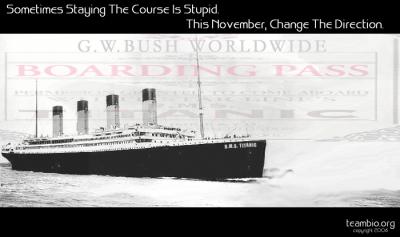
Image Grabbed From BIO

"A Beacon Of Hope?"

As we celebrate our independence, Americans can take pride in our history and look to the future with confidence. We offer our gratitude to all the American patriots, past and present, who have sought to advance freedom and lay the foundations of peace. Because of their sacrifice, this country remains a beacon of hope for all who dream of liberty and a shining example to the world of what a free people can achieve. May God continue to bless the United States of America.
If you ask me, the President has done much to put out the beacon rather than make it shine brighter. What do you think?

Taking Comfort, or Not.

Of course, the President is on another American Taxpayer supported PR Junket to the midwest - Just one quick question, would you take comfort, given the current situation in Iraq, if the President met with you to "express our country's gratitude for their[your relative's] service?"
3:41 P.M. CDT

THE PRESIDENT: I want to thank you all for coming. I just had a discussion with fellow citizens in the Guard, Reserve and active duty who have been in both Iraq and Afghanistan. I want to thank you for sharing your insights with me. Thank you for your service to the country.

I told these men and women that their service is necessary for the security of the United States of America, and that they're serving in historic times. And one day their children will be able to look back and say, my dad, or my mom went to Iraq and Afghanistan and helped a young country become a democracy, and therefore the world is more peaceful for it.

One of the things I am going to do is I'm going to meet with the family members of these good people, and express our country's gratitude for their service, as well. A lot of times military families don't get proper thanks, and I can't wait to meet your loved ones and tell them firsthand that the country appreciates your service.

One thing I told these good folks is that this country stands with people who are defending our nation. We're with you. We know the work is hard, but the work is necessary. And we're winning; and we're winning. And the world is going to be better off because of your courageous service, and I thank you for it.

Thanks for letting me come by and visit.

END 3:43 P.M. CDT
What would you say to the man if he met with you in such a capacity?

Tuesday, June 27, 2006

Staying The Course In Iraq Gets You...


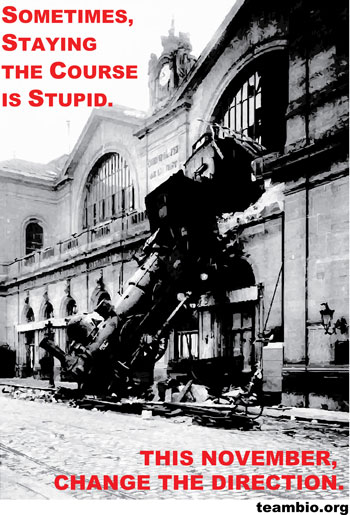
Image grabbed from BIO location

"We Are Going To Be Perfectly Circular With You Here:" Another Political Parlor Trick Exposed By The Perpetrators

If there was a second whitehouse beat reporter that I enjoy after Helen Thomas, it's Victoria (I don't know what her last name is. Does any one out there know?). Well, okay, except for Lester (also don't know his last name), for entertainment value, maybe.

You have to love it when the Press Secretary exposes himself in public and then identifies the political parlor tricks (for which the W, Rove and Co. claim to have such disdain)they will used to keep the American people in the dark. Enjoy:
Victoria.

Q I talked yesterday with somebody from the NSC about the telephone records being handed over -- by the telephone companies to the NSA. And they wouldn't confirm or deny the existence of the program.

MR. SNOW: Right.

Q Now, as far as the SWIFT financial records issue that was reported in The New York Times, you seem to have confirmed the existence of that program by the way that you've been talking from the podium.

MR. SNOW: That is correct.

Q So if that's the case, and the telephone records program was written about also in The New York Times and in USA Today, why not just go ahead and either confirm or deny the existence of this program and just lay the whole thing to rest?

MR. SNOW: Because we are neither going to confirm, nor deny. We are going to be perfectly circular with you here. But having neither confirmed, nor denied before, we're not going to do it. In the particular case with The New York Times, there was a concerted effort to lay before the newspaper the full facts and to try to make the argument that while it might make a good story, it's bad in terms of national security. As far as the other program, we just have never confirmed or denied the details.

When Snow Melts Himself

Okay, so the W, Rove and Co. argument goes: If we leak (who's fault is that, btw) top secret information and it is published in the press, it will hurt our efforts to stop bad people from doing bad things. Okay, just one question: If you can't predict the future, how do you know this is the case? Remember, this is just like the whole WMD ploy - the absence of evidence is not evidence of absence. As Radar O'Reily used to say, "Wait for it." Tony the Snow-job commits rhetorical suicide for the W, Rove and Co one more time. The trouble is, the American people are too busy to notice that he melts his own argument:
Q Tony, regarding the disclosure last week of the SWIFT monitoring program, I understand the theoretical argument that this impedes the ability to conduct intelligence, but does the White House know for a fact that it's demonstrably changed and lessened the ability --

MR. SNOW: We took this up yesterday, which is, you're not going to be able to assess definitively within a day. But I think what you're likely to have is negative confirmation in the sense people change their behavior. This is a program that had worked, that had worked -- not only had been successful in intercepting terrorist funding and foiling terrorist plots and saving lives. And The New York Times story itself said as much. It's not as if terrorists are going to say, oops, got to stop doing that. You're not likely to get a lot of intel traffic. But on the other hand, I can imagine that over a period of time you're going to see some sort of patterns emerge.

Keep in mind also the idea that there's going to be a snap decision on this. The way the program worked was, you did not track bank transfers in real time. There was a lag. For instance, if you were going to seek a subpoena, you would have to cite specific intelligence, it would have to be reviewed by outside auditors, it would have to have allowed a certain amount of time to elapse. None of those things have had time to proceed. So we really don't have any basis right now for knowing exactly how it's influenced things, but I think it is safe to say that once you provide a piece of intelligence, people on the inside act on it.
We all know that any sentence that includes a "but" is only partially received and perceived. Which part of Tony's statement will be remembered?